
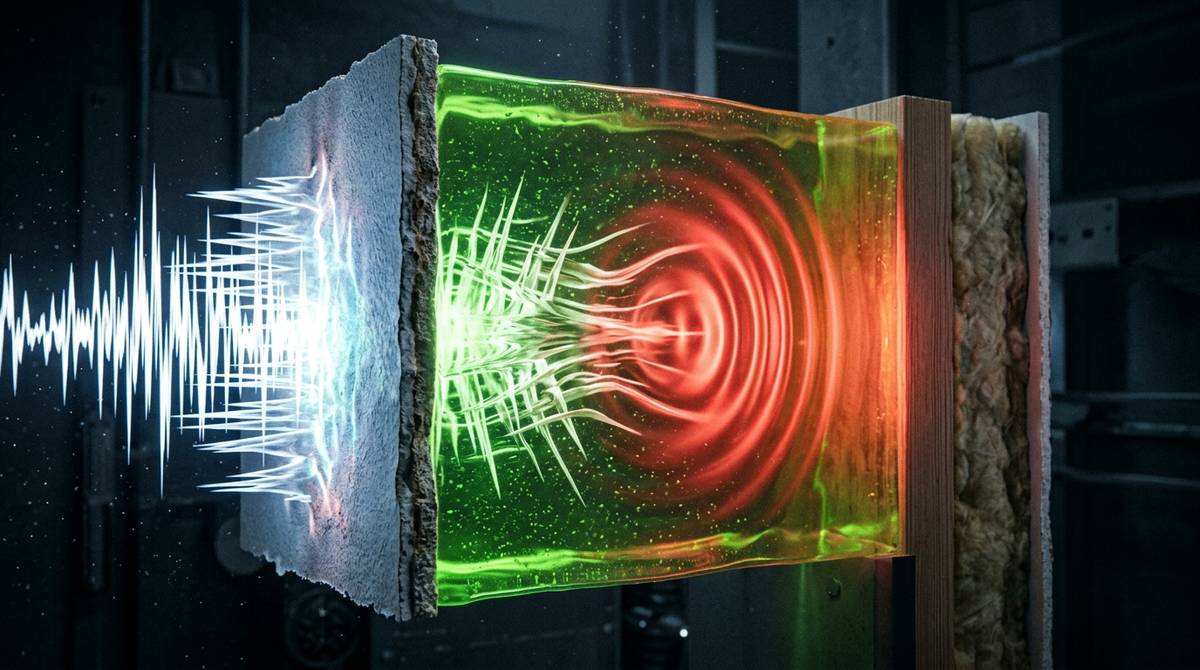
When designing a dedicated home theater, achieving total acoustic isolation is the holy grail of the construction process. A high-end audiovisual system is capable of producing extreme acoustic energy, often hitting peaks of 110 to 120 decibels. If a room is not properly sealed, this audio will effortlessly bleed into adjacent bedrooms, living spaces, and even neighboring properties. When architects and acoustic engineers attempt to contain this massive wall of sound, they generally have to choose between two different fundamental physics principles. As industry experts note, “There are a variety of techniques to reduce noise and vibration in a home theater or media rooms. Most approaches rely on one of two principles: mass or damping”.
For decades, adding mass was the only recognized way to build a soundproof wall. However, modern architectural science has undergone a massive shift toward a highly engineered technology known as viscoelastic damping. If you are investing in a media room, understanding the vast differences between these two methodologies will dictate the structural integrity, square footage, and ultimate success of your project. Here is an in-depth look at how traditional mass-loaded barriers compare to modern viscoelastic damping.
Subscribe
Enter your email below to receive updates.
Traditional Mass-Loaded Barriers: The Brute Force Approach
To understand why a new technology was needed, you must first understand the mechanism and limitations of the old technology. Traditional acoustic construction relies almost entirely on a concept known as the Mass Law.
“Traditional sound barriers follow Mass Law, which states that the heavier an object is, the more energy it takes to vibrate it”.
Sound travels through walls as physical, vibrational energy. When the sound waves from your home theater speakers crash into the drywall, the drywall acts like a drum skin, absorbing the acoustic energy and vibrating. This vibration travels through the rigid wooden wall studs to the drywall on the opposite side, which vibrates and recreates the noise in the next room. The Mass Law dictates that if you make the wall heavy and dense enough, the sound waves simply will not have enough acoustic energy to cause the structure to vibrate.
When taken to the extreme, the Mass Law works perfectly. For instance, “Eight inches of solid concrete is considered an excellent sound barrier”. The sheer density of a thick concrete bunker makes it practically immune to acoustic vibration.
However, pouring eight inches of solid concrete is entirely impractical for a standard residential home retrofit. Because true mass is so difficult to achieve in a wood-framed house, homeowners and contractors often attempt to artificially “mass-load” their standard walls by adding bulky, heavy materials. The most common DIY mass-loading techniques include:
- Adding multiple extra layers of standard gypsum (drywall) to the wall frame.
- Installing thick soundboards under the drywall.
- Hanging heavy, mass-loaded vinyl sheeting inside the wall cavities.
The Failure of Mass-Loaded Walls in Home Theaters
While adding mass-loaded vinyl or extra layers of drywall seems intuitively correct, rigorous laboratory testing reveals that these “old school” mass-loaded barriers fail miserably when subjected to the extreme decibel levels of a modern home theater.
There is a widespread “common misconception” that putting mass-loaded vinyl beneath drywall “will reduce noise by 27dB”. However, accredited acoustic test results show that using mass-loaded vinyl only yields a disappointing “3-9dB reduction (at 1 lb/ft²)”. In a room generating 110 decibels of noise, a 3 to 9 decibel reduction is practically useless; the noise bleeding into the rest of the house will still be overwhelmingly loud.
The failure of mass-loaded barriers becomes even more apparent when dealing with the deep, low-frequency bass (LFE) generated by home theater subwoofers. When acoustic laboratories test how well mass-loaded walls block frequencies at 50 Hertz (Hz), the results are incredibly poor. If a builder attempts to use mass by putting “Double gypsum both sides single stud,” the resulting transmission loss at 50Hz is a miserable “16dB”.
Ultimately, trying to use the Mass Law in a residential space requires sacrificing valuable square footage to build incredibly thick walls, wasting money on heavy materials, and still failing to stop the deep rumble of cinematic bass.
Viscoelastic Damping: The Modern Engineering Solution
Because of the severe limitations of mass-loaded barriers, acoustic engineers pioneered a radically different approach to sound containment: viscoelastic damping.
Instead of trying to stop sound through brute force and heavy weight, companies have developed “a series of advanced technology drywalls and woods designed for superior noise reduction”. Rather than relying on sheer density, these specialized building materials “use a patent pending viscoelastic polymer approach with ‘constrained layer damping’ to fundamentally change the way sound moves through walls, ceilings and floors”.
Viscoelastic materials have a unique physical property: they exhibit both viscous (fluid-like) and elastic (solid-like) characteristics when undergoing deformation. When acoustic energy hits a standard, rigid piece of drywall, the rigid drywall transfers the vibration directly to the studs. However, when acoustic energy hits a panel equipped with a viscoelastic polymer, the polymer layer chemically converts the mechanical vibrational energy into a microscopic amount of heat. This safe dissipation of energy stops the sound wave dead in its tracks before it can travel any further.
The “Room-Within-A-Room” Effect
The most crucial difference between mass-loading and viscoelastic damping is how the materials interact with the wooden framing of the house.
Mass-loaded materials, no matter how heavy they are, are usually screwed directly into the wall studs, maintaining a rigid, mechanical bridge for sound to travel across. Constrained-layer damping works by breaking that bridge.
“Basically, damping built into these enhanced panels isolates the face of the wall from the studs”. By using materials like internally damped QuietRock or viscoelastic acoustic adhesives like QuietGlue, you effectively decouple the hard surface of the wall from the structural framing.
As acoustic experts explain, “It is as if you built a room-within-a-room, only at a microscopic level”. Building a true, physical room-within-a-room (where you build a secondary floating wall frame entirely detached from the existing house) is the most expensive and space-consuming architectural acoustic method in existence. Viscoelastic damping achieves this same decoupling effect on a molecular level, because “This new sound isolation technology exploits the viscoelastic properties of polymeric materials”.
The Decibel Difference: Damping Outperforms Mass
The ultimate proof of viscoelastic damping’s superiority lies in the laboratory testing data. When compared side-by-side, the performance gap between old-school mass-loading and modern damping is staggering.
When architects ask if they need to build a thick wall with layer after layer of high mass materials, the data provides a clear answer: “In these situations, using constrained-layer damping rather than mass can yield excellent results”.
In fact, the tests show that “a damped drywall or wood panel can achieve even higher STC Ratings than a mass-loaded wall – with less material, less weight and less bulk”.
Let’s look specifically at the notoriously difficult low-frequency bass response at 50Hz. As noted earlier, a heavy mass-loaded wall using double standard gypsum on both sides only yields a 16dB loss at 50Hz.
In stark contrast, if a builder uses viscoelastic damping by installing “QuietRock 545THX both sides (double stud),” the wall achieves a massive “42dB” loss at 50Hz, and an overall Sound Transmission Class (STC) rating of 54. If the builder takes it a step further and uses “2X QuietRock 545THX both sides (double stud),” the low-frequency loss jumps to an incredible 45dB at 50Hz, with an overall STC of 59.
Subscribe
Enter your email below to receive updates.
Conclusion
The difference between traditional mass-loaded sound barriers and viscoelastic damping is the difference between an outdated, inefficient methodology and cutting-edge acoustic science. Attempting to fulfill the Mass Law in a residential home theater requires enormous amounts of thick, heavy materials like extra drywall and mass-loaded vinyl, yet still fails to effectively block low-frequency subwoofer bass,. Viscoelastic constrained-layer damping, on the other hand, fundamentally changes the way sound travels, isolating the drywall from the framing to create a microscopic room-within-a-room. By converting acoustic vibrations into heat, viscoelastic damping provides vastly superior sound isolation and STC ratings, utilizing less material, weight, and bulk to achieve true cinematic silence.

Leave a Reply