
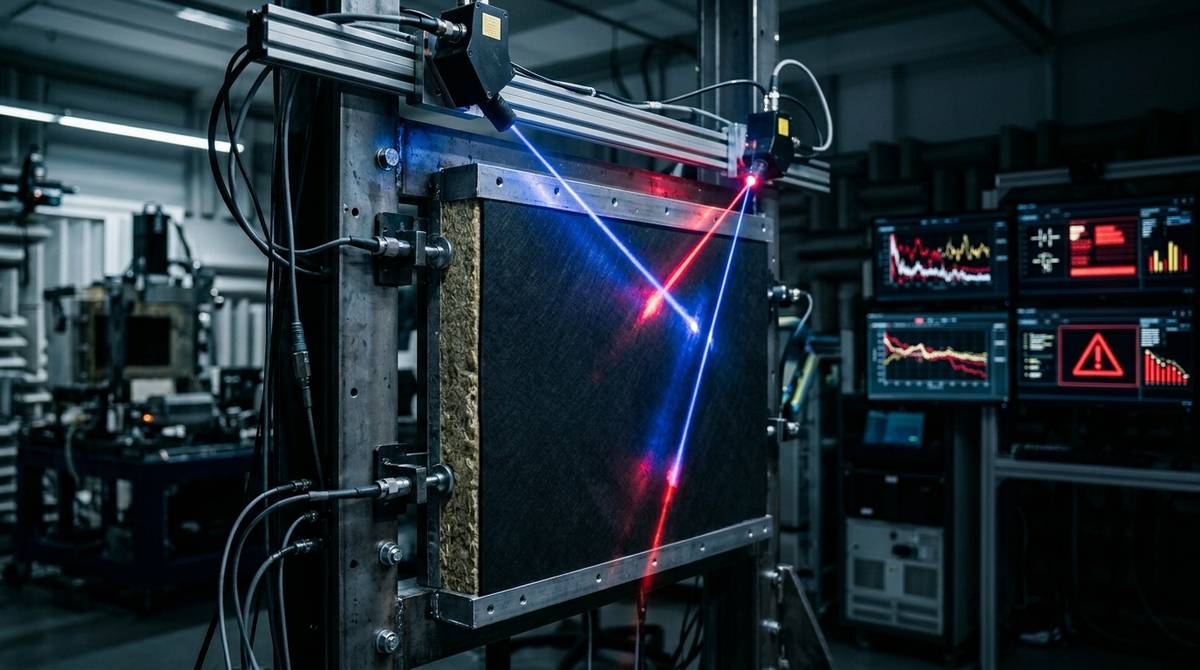
When homeowners and custom builders set out to design a dedicated home theater or a high-end media room, they immediately face the daunting challenge of sound containment. A premium surround-sound system is capable of producing immense acoustic energy, frequently reaching peaks of 110 to 120 decibels (dB). To prevent this massive wall of sound from bleeding into adjacent bedrooms or disturbing the neighbors, the room must be heavily soundproofed.
In the search for soundproofing solutions, many DIY enthusiasts and general contractors turn to traditional, “old school” methods. Two of the most popular legacy materials recommended in online forums and hardware stores are Mass-Loaded Vinyl (MLV) and Acoustic Soundboards (often installed directly beneath standard gypsum drywall).
While these materials seem like logical choices, modern architectural acoustic testing has exposed a harsh reality: these traditional mass-loaded barriers perform exceptionally poorly when subjected to the extreme demands of a home cinema. If you are investing in a custom theater, relying on these outdated materials can lead to ruined acoustics, wasted money, and severe noise complaints. Here is an in-depth, scientific look at why mass-loaded vinyl and soundboards fail in modern laboratory tests, the physics of sound transmission, and the modern engineering solutions you should use instead.
Subscribe
Enter your email below to receive updates.
The Misapplication of the “Mass Law”
To understand why MLV and soundboards under drywall perform so poorly, we must first look at the foundational physics principle they attempt to utilize: the Mass Law.
In the world of architectural acoustics, there are two basic approaches to treating a room for noise containment: sound barriers and sound absorbers. Sound barriers are specifically designed to reduce the transmission of sound from one space to another. Historically, these traditional sound barriers follow the “Mass Law,” which dictates that the heavier and denser an object is, the more acoustic energy it takes to physically cause that object to vibrate.
When applied in its purest form, the Mass Law is highly effective. For instance, acoustic engineers consider eight inches of solid, poured concrete to be an excellent sound barrier. The sheer immense weight of a thick concrete wall makes it incredibly difficult for soundwaves to move it.
However, achieving this level of mass is entirely impractical in a standard residential, wood-framed home. Because homeowners cannot easily pour eight inches of concrete into their second-floor media rooms, they attempt to artificially “mass-load” their standard wooden stud walls by adding dense, heavy materials like MLV or specialized soundboards beneath their drywall. The fatal flaw in this approach is that adding thin layers of mass to a rigid wooden frame simply does not provide enough sheer density to stop high-decibel acoustic energy.
The Myth vs. Reality of Mass-Loaded Vinyl (MLV)
Mass-loaded vinyl (MLV) is a dense, flexible sheet of material—often infused with barium salts or silica to increase its weight—that is typically hung against the wall studs before the standard gypsum drywall is screwed into place. The theory is that this heavy limp mass will block the soundwaves before they can enter the wall cavity.
Because MLV is heavy and relatively expensive, it has garnered a legendary, almost mythical reputation in the DIY audio community. In fact, many people harbor the serious misconception that putting mass-loaded vinyl beneath drywall will result in a miraculous reduction in noise transmission.
The most common misconception regarding MLV is the widely circulated claim that it “will reduce noise by 27dB”.
However, when accredited acoustic laboratories put this claim to the test using rigorous, modern measurement standards, the results are incredibly disappointing. Actual laboratory test results show that installing mass-loaded vinyl beneath drywall only provides a meager 3 to 9 decibel (dB) reduction (at 1 lb/ft²).
To understand why a 3 to 9 dB reduction is a failure for a home theater, you must consider the volume of the room. A high-performance theater routinely hits 110dB audio peaks. If your standard wall only blocks 34dB of sound, adding MLV might raise that blockage to 40dB or 43dB. This means nearly 70 decibels of noise will still bleed directly into the adjacent room. A 70dB noise level is equivalent to running a loud vacuum cleaner in the hallway. The MLV fails to provide the true acoustic isolation required for a peaceful home.
The Disappointment of Acoustic Soundboards
Another incredibly common “old school” approach is the use of acoustic soundboard (sometimes marketed under brand names like SoundBarrier). Soundboard is typically a dense, fibrous board made from compressed wood or paper fibers. Builders frequently install a layer of this soundboard directly against the wooden wall studs, and then screw the standard gypsum drywall directly over it, sandwiching the soundboard in the middle.
Similar to MLV, soundboard benefits from a strong historical reputation. The common misconception among contractors and homeowners is that using soundboard under gypsum is “recognized as an effective method” for soundproofing a room.
Unfortunately, modern acoustic testing completely debunks this reputation. Laboratory test results prove that using soundboard under standard gypsum only provides an unimpressive 3 to 6 decibel (dB) of reduction.
Why does it fail? The problem lies in mechanical coupling. Even if the soundboard adds a slight amount of density to the wall, the standard drywall is still rigidly screwed through the soundboard and directly into the wooden wall studs. When the powerful soundwaves from your surround-sound speakers strike the drywall, the acoustic vibration travels straight through the mounting screws, past the soundboard, into the rigid wood studs, and directly into the adjacent room. The wall remains a highly efficient mechanical bridge for noise.
The Ultimate Failure: Low-Frequency Subwoofer Bass
The performance of mass-loaded vinyl and soundboards looks even worse when we evaluate how they handle the most difficult aspect of home theater soundproofing: deep, low-frequency bass.
In the construction industry, the sound-blocking capability of a wall is graded using a single-number metric called the Sound Transmission Class (STC). However, the STC measurement method is fundamentally flawed for home theaters because it only calculates transmission loss for frequencies between 125 Hertz (Hz) and 4000 Hz. It completely ignores the deep Low Frequency Effects (LFE) generated by home theater subwoofers, which frequently plunge down to 50Hz, 30Hz, or lower.
To see how a wall actually performs against a subwoofer, acoustic engineers must obtain the “TL” (Total Loss) measurements at 1/3rd octave bands down to 50Hz. Because low frequencies carry immense kinetic energy, they easily bypass thin layers of mass.
When builders attempt to satisfy the “Mass Law” by piling heavy materials onto a wall—such as building a “double gypsum both sides single stud” wall—the results at 50Hz are disastrous. Testing shows that a standard single stud wall with double gypsum on both sides only provides a pathetic 16 decibels of loss at 50Hz. Relying on basic mass-loading materials like extra drywall, MLV, or soundboards leaves your home completely defenseless against the deep, physical rumble of cinematic bass.
The Modern Solution: Viscoelastic Constrained-Layer Damping
Because traditional mass-loaded barriers perform so poorly in modern tests, the acoustic engineering industry has shifted its focus away from adding heavy bulk to residential walls. Today, there are a variety of techniques to reduce noise and vibration in a home theater, and most approaches rely on one of two principles: mass or damping.
Since mass is inefficient and space-consuming, modern home theaters utilize advanced viscoelastic damping.
Leading acoustic companies have developed a series of advanced technology drywalls (like QuietRock) and woods (like QuietWood) that are specifically designed for superior noise reduction. Rather than relying on heavy, limp mass like MLV or fibrous soundboards, these engineered panels use a patent-pending viscoelastic polymer approach combined with “constrained layer damping”.
This technology fundamentally changes the way sound moves through the walls, ceilings, and floors of your home. The viscoelastic polymer is trapped (constrained) inside the core of the drywall panel. When acoustic energy hits the wall, the polymer chemically converts the vibration into a microscopic amount of heat, safely dissipating the sound before it can travel into the wall studs.
Basically, the damping built into these enhanced panels physically isolates the face of the wall from the studs. As acoustic experts explain, using this technology is “as if you built a room-within-a-room, only at a microscopic level”.
Subscribe
Enter your email below to receive updates.
Conclusion: Damping Outperforms Mass
The debate between traditional DIY soundproofing and modern acoustic engineering is settled by the testing data. When asked if a builder needs to use layer after layer of high-mass materials, the answer is clear: using constrained-layer damping rather than mass yields vastly superior results.
A properly damped drywall or wood panel can achieve significantly higher STC ratings than a traditional mass-loaded wall—doing so with less material, less weight, and less structural bulk. By abandoning outdated, poor-performing materials like mass-loaded vinyl and acoustic soundboards, and investing instead in modern viscoelastic damping, you can successfully contain 110-decibel audio peaks and ensure your home theater remains a truly isolated, private sanctuary.


Leave a Reply