
When setting out to build a dedicated custom cinema, most homeowners immediately start browsing for the brightest 1080p native projectors and the most powerful surround-sound receivers. However, according to John Dahl, the director of education for THX, this approach is entirely backward. THX guidelines insist that the room itself, along with the seating layout, must be planned before a single piece of audiovisual equipment is purchased.
A foundational part of “planning the room” is calculating its acoustic containment. If you install a massive, commercial-grade audio system in a room built with standard residential drywall, the resulting noise pollution will render the room practically unusable. You will disturb family members trying to sleep, and you may even violate local noise ordinances. To prevent this, architects and acoustic engineers use a specific mathematical formula based on the Sound Transmission Class (STC) to design the room’s walls, floors, and ceilings.
Here is the ultimate guide to understanding home theater decibel output and how to calculate the exact STC rating you need to perfectly isolate 110dB audio peaks.
Subscribe
Enter your email below to receive updates.
The Reality of Home Theater Decibels (dB)
Before you can calculate how much soundproofing you need, you must establish how much noise your room will actually generate.
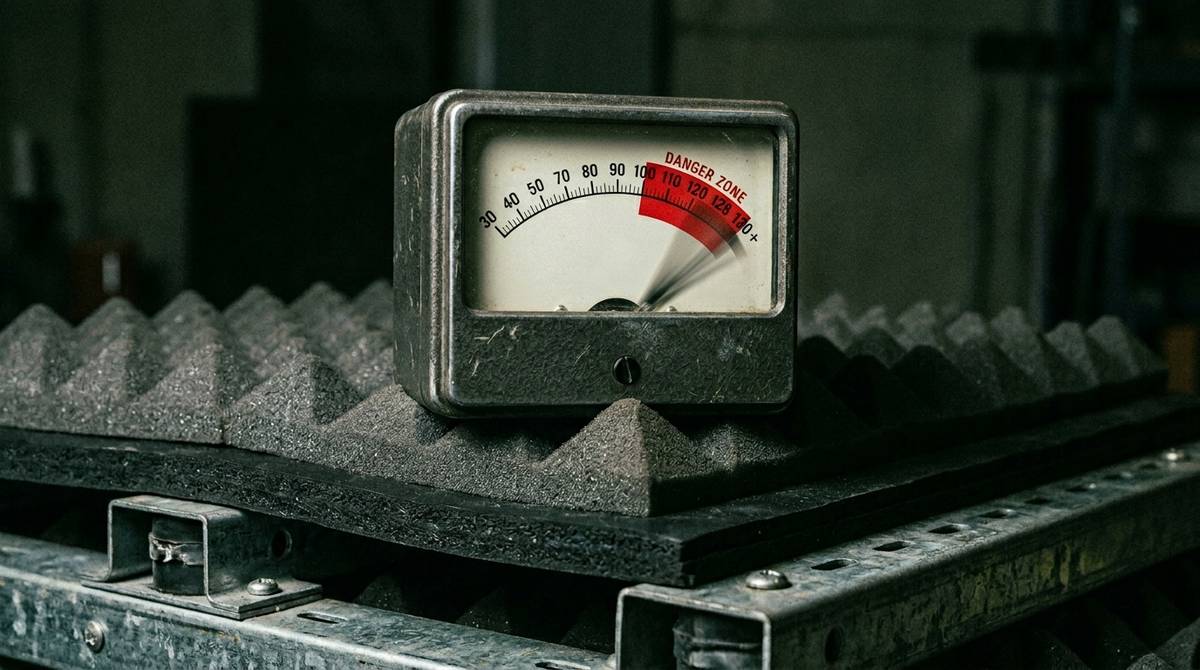
Sound volume is measured in decibels (dB). For context, a standard, quiet living room has an ambient noise level of roughly 40dB. Normal, conversational speech registers at about 60dB. However, a high-performance home theater is designed to replicate the dynamic range of a commercial cinema, which means it gets incredibly loud. Reference-level media rooms regularly produce audio peaks of 100 to 120 decibels (dB) during intense action sequences, explosions, or heavy musical scores.
Generating 110dB to 120dB of sound is equivalent to standing near a live rock concert or a jet engine. If your home theater is located next to a bedroom, above a living room, or in a basement directly below the main floor, that 110dB of acoustic energy acts like water—it will forcefully seek out any structural weakness and flood into the adjacent rooms.
Furthermore, failing to contain this extreme volume isn’t just an annoyance for your family; it can become a legal issue. In many municipalities, noise pollution laws dictate that audio equipment cannot produce noise that exceeds five decibels above the ambient background noise level of your neighborhood. If your 110dB theater leaks sound through exterior walls and bothers the neighbors, you could face legitimate noise complaints.
The Core STC Calculation Formula
To stop 110dB peaks from destroying the peace of your home, you must utilize the Sound Transmission Class (STC) rating system. STC is the universally accepted single-number rating used by architects, contractors, and acoustic product manufacturers to describe how much sound reduction a specific wall or ceiling barrier provides.
The math used to determine your required STC rating is a straightforward subtraction equation: Home Theater Peak Volume (dB) – Wall STC Rating = The Resulting Noise in the Adjacent Room (dB).
To understand how this calculation dictates your construction choices, let’s look at an example. A standard interior residential wall—built with a single row of wood studs and a layer of standard drywall on each side—typically has an STC rating of around 34.
If you unleash a 110dB movie explosion in a room with an STC 34 wall, the math is brutal: 110dB – 34 STC = 76dB.
A noise level of 76dB will easily bleed into the adjacent room. This is equivalent to running a vacuum cleaner or standing in busy city traffic. Anyone trying to sleep, read, or have a conversation in the next room will be completely overwhelmed.
Conversely, if you engineer a highly specialized acoustic wall with an STC rating of 70, the calculation changes dramatically: 110dB – 70 STC = 40dB. Because 40dB is considered a “very quiet” sound level, a wall with an STC of 70 effectively renders a booming 110dB home theater completely silent to anyone standing in the adjacent room.
The Four Target Tiers for Home Theater Soundproofing
Using the calculation above, acoustic experts have established four distinct target tiers for home theater sound containment. Knowing your budget and how quiet you need the rest of your house to be will dictate which of these STC targets you must build toward:
1. The “Basic” Target (STC 50)
- The Calculation: 110dB – 50 STC = 60dB in the adjacent room.
- The Result: 60dB is roughly the volume of a normal conversation. While people in the next room will clearly hear muffled dialogue and effects, it is a massive improvement over standard drywall.
2. The “Good” Target (STC 60)
- The Calculation: 110dB – 60 STC = 50dB in the adjacent room.
- The Result: 50dB is equivalent to the ambient hum of a quiet office building. You will hear the theater operating, but it will not be overwhelmingly disruptive to daily daytime activities.
3. The “Superb” Target (STC 70)
- The Calculation: 110dB – 70 STC = 40dB in the adjacent room.
- The Result: At 40dB, the adjacent room remains very quiet. You can confidently watch movies late at night without waking people sleeping in nearby rooms.
4. The “THX / Ultimate” Target (STC 80)
- The Calculation: 110dB – 80 STC = 30dB in the adjacent room.
- The Result: Absolute, dead silence. Even if the theater hits peak levels of 120dB, the sound leaking into the next room will only be 40dB, maintaining total isolation.
The Limitation of STC: The Low-Frequency Trap
While mastering the STC calculation is essential for blocking dialogue, high-pitched action sounds, and general midrange frequencies, you must be aware of one critical flaw in the STC measurement standard: It does not account for deep bass.
Laboratory STC measurements only test a wall’s transmission loss at frequencies ranging from 125Hz to 4000Hz. However, the massive subwoofers required for high-end home theaters generate powerful Low Frequency Effects (LFE) that regularly plunge down to 50Hz, 30Hz, or even 20Hz.
Because the standard STC calculation ignores frequencies below 125Hz, a wall might score an impressive STC of 60 on paper, but still allow the physical, vibrating rumble of a 50Hz explosion to effortlessly pass through the studs.
To ensure your calculated STC rating actually holds up against a movie soundtrack, you must ask your acoustic designer or contractor for the wall’s Total Loss (TL) measurements at 1/3rd octave bands down to 50Hz.
To successfully block these low frequencies, you cannot rely on traditional “Mass Law” techniques—such as stuffing standard fiberglass insulation into the walls or adding standard mass-loaded vinyl, which only yield a meager 2-4dB or 3-9dB of reduction, respectively. Instead, you must use modern “constrained-layer damping” techniques. Using specialized viscoelastic polymers (like QuietGlue or internally damped QuietRock drywall) fundamentally changes the way sound moves, isolating the face of the drywall from the framing itself and creating a microscopic “room-within-a-room” that stops bass dead in its tracks.
Subscribe
Enter your email below to receive updates.
Conclusion
Before you map out your speaker placement or buy a 120-inch projection screen, you must calculate your required STC rating. By understanding that your theater will routinely hit 110 decibels, you can use the simple STC subtraction formula to determine exactly how much acoustic isolation you need to keep the adjacent rooms at a peaceful 40dB. Aim for an STC rating between 70 and 80, ensure your materials offer high Total Loss (TL) at 50Hz, and you will guarantee that your private cinema remains a sanctuary without disturbing the rest of your home.


Leave a Reply