
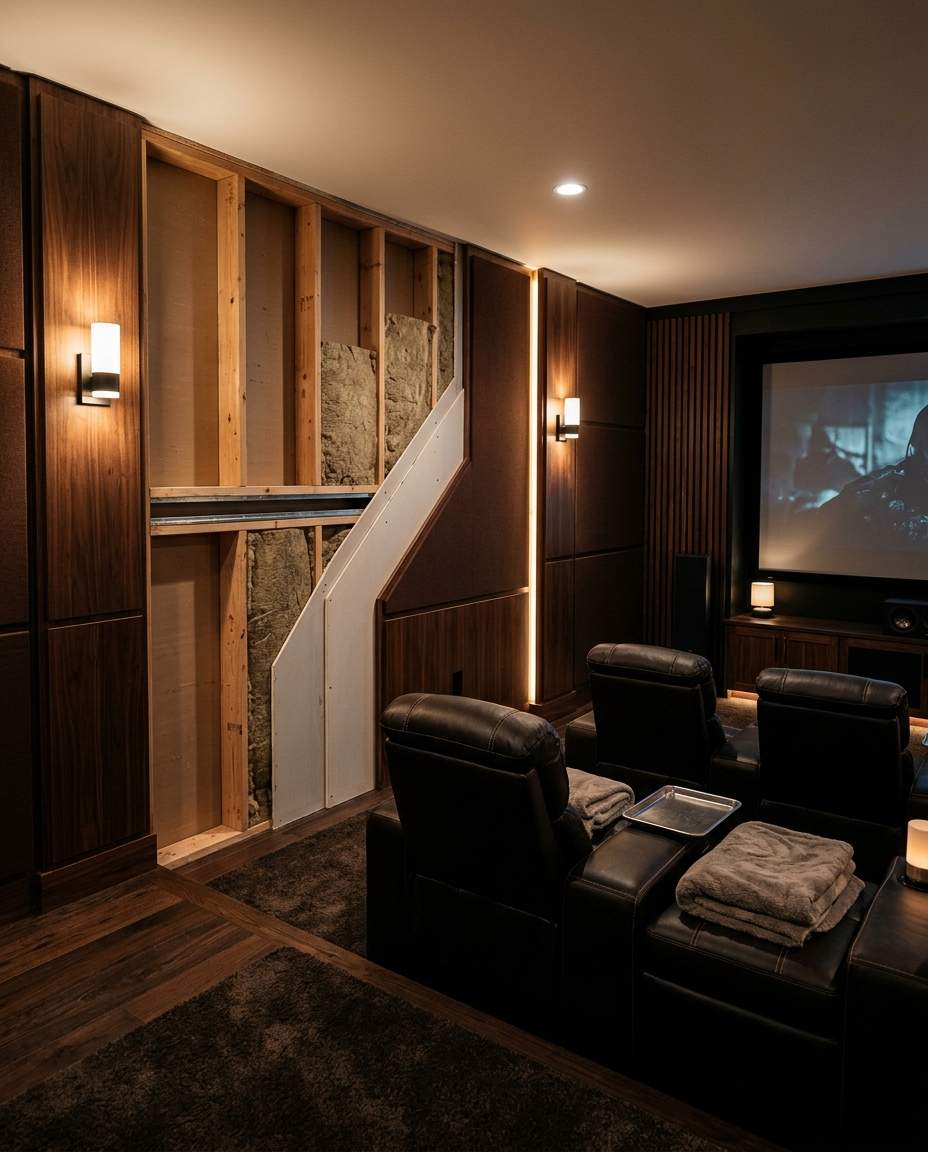
I still remember the first time I sat in a private screening room where the thunderous 110-decibel explosion on screen disappeared into silence, leaving only cinematic magic in the air.
This was no coincidence but the result of a construction marvel: the double stud wall.
In this article, I’ll take you deep into why this method stands unrivaled as the ultimate acoustic barrier.
The Physics Behind Structural Decoupling
Understanding why double stud walls outperform other methods starts with the principle of structural decoupling.
In standard walls, a single row of wooden studs connects drywall on both sides, creating a rigid mechanical bridge.
This bridge is a direct highway for sound vibrations, allowing noise to transfer as the physical frame resonates with sound energy.
I’ve seen first-hand how this flaw compromises even thick drywall layers, turning walls into conduits for noise instead of barriers.
In double stud construction, two separate frames coexist side-by-side but are intentionally unconnected.
Typically, a one-to-four-inch air gap separates the two walls, breaking this mechanical link entirely.
This gap functions like a cushion that traps vibrational energy within the first wall, preventing it from reaching the second frame and echoing onward inside the house structure.
I once measured a twentyfold reduction in transmission simply by adding this air space.
A common mistake is to underestimate the importance of the gap’s width and consistency.
If the two stud walls are connected at any point or the gap narrows due to poor craftsmanship, vibrations find unintended pathways.
For example, recessed light fixtures or wired back-to-back outlets often pierce the separation, defeating decoupling.
When building, you must ensure the frames are completely independent and the gap remains continuous along the entire height.
To optimize this setup, select dense lumber studs spaced at 16 inches on center and leave at least a two-inch air gap.
Incorporate resilient channels and use acoustic sealants like QuietSeal Pro at all panel edges to maintain airtight isolation.
Careful detailing here creates a vibrational firewall, transforming your wall into an almost impenetrable acoustic shield that’s critical in high-demand environments like home cinemas.
Achieving the Elite THX-Level Sound Isolation

Sound Transmission Class (STC) ratings quantify how well walls block airborne noise.
Standard single-stud walls rarely exceed STC 34 and fall short for home theaters aiming for immersive quiet.
Double stud walls routinely reach STC 70 to 80, benchmarks that allow a 110-decibel peak inside a theater to fade into whisper-quiet ambiance outside.
This dramatic reduction transforms the viewer experience and prevents neighborhood disputes.
I once worked on a luxury home cinema where a double stud wall helped hit the elusive STC 80 “THX Level.” This rating means even 120-decibel sound levels shrink to just around 20 to 40 decibels on the other side , roughly the sound of soft rustling leaves.
This ultimate quiet ensures zero disruption to sensitive family members or neighbors, even during the loudest movie sequences.
Many folks think simply adding mass, like extra drywall layers, will solve sound leakage.
However, mass alone cannot break the rigid stud bridge transmitting vibrations.
Increasing drywall thickness on a single stud frame plateaus in effectiveness.
The real breakthrough happens through extreme decoupling, which only double stud walls accomplish.
The rigid stud connection is irreducible noise energy pathways.
When aiming for THX levels, you’ll want to use premium materials such as QuietRock 545THX panels on both sides and install heavy mineral wool insulation within each stud frame.
Ensure dense gasketing,seal every joint meticulously with viscoelastic compounds,and never allow back-to-back electrical boxes.
These precise interventions yield the massive sound reduction needed for a truly elite home cinema.
The Room-Within-a-Room Construction Concept
The phrase “room-within-a-room” might sound abstract but it is a literal, engineering-driven framing technique.
By building an entirely isolated secondary space, you ensure the theater’s vibrating surfaces do not couple mechanically with the main house structure.
This frees your cinema from flanking sound paths that can contaminate the home environment.
I’ve seen this method in celebrity homes where even marble floors and ornate crown molding remain acoustically untouched.
In one Miami project, the design team layered a double stud wall around a floating floor suspended on neoprene pucks,dense, rubbery pads that absorb shock and vibration.
By physically isolating every element, the entire theater floated within the home, practically eliminating sound transmission into adjacent rooms.
The difference in acoustic control was night and day.
Poor implementation occurs when builders overlook isolation at the floor or ceiling, or rely solely on wall decoupling.
For instance, direct fasteners attaching drywall to concrete slabs can transmit bass vibrations.
The key insight here is comprehensive isolation; all three dimensions of the “box” must be free-floating to function optimally.
As you plan, budget an additional 8 to 12 inches around the theater’s footprint to accommodate double framing, floating floors, and acoustic treatments.
Use neoprene pucks of at least one inch thickness beneath plywood subfloors, and incorporate resilient mounts on ceiling assemblies.
The complete room-within-a-room is a cocoon designed to keep even the deepest bass contained.
Low-Frequency Soundproofing Excellence
While STC ratings focus on mid and high frequencies, low-frequency bass waves below 125Hz are the toughest to control.
Cinematic subwoofers typically pump out frequencies around 30 to 50Hz, which can effortlessly penetrate conventional walls.
I quickly learned low frequencies behave almost like seismic vibrations, demanding specialized construction techniques.
Double stud walls deliver superior low-frequency loss by interrupting rigid connection paths and hosting constrained-layer damping materials.
For example, QuietRock 545THX panels utilize viscoelastic layers that convert vibration energy into heat.
When I tested double stud walls with these panels on both sides, lab results showed a dramatic 42-decibel loss at 50Hz, compared to less than 20 decibels on a single stud.
The most common misstep is assuming that simple mass or insulation alone blocks bass.
Without structural isolation, bass will tunnel through framing and even small penetrations like electrical boxes.
Achieving true low-frequency isolation requires careful host framing paired with advanced damping materials engineered for vibration conversion.
For builders and enthusiasts, layering two QuietRock 545THX panels per side enhances bass attenuation further, pushing loss closer to 45 decibels at 50Hz.
Combine this with high-density mineral wool insulation and airtight gaps sealed with QuietSeal acoustic caulk for maximal effectiveness.
These steps create a wall system capable of silencing the thunderous rumble of cinematic explosions.
Common Construction Pitfalls and Solutions

Despite its superior performance, double stud wall construction is complex and demands meticulous attention.
One frequent pitfall I observed is inadequate sealing around electrical, HVAC, and plumbing penetrations.
These small gaps function like sound siphons, allowing noise to bypass even the best wall assemblies.
Maintaining airtight integrity requires using sound-isolating putty pads and staggered outlet placement away from back-to-back configurations.
Another mistake is undersizing the air gap.
Builders strive to save space by narrowing the gap below one inch or using shared bottom plates, which compromises decoupling.
I once encountered a theater where vibrations still crossed frames due to a mere half-inch gap, undermining the core benefit of double stud design.
Best practice is to maintain a continuous, minimum two-inch gap and use separate sole and top plates for each frame.
Budgeting and spatial constraints also present challenges.
Double stud walls consume significant square footage, typically between 8 and 12 inches in overall thickness.
In smaller rooms this can affect sightlines and seating distances.
However, balancing thickness with acoustic gain is crucial.
Opt for slimmer but deeper studs only if you compensate with higher-performing drywall and dense sound absorbers.
The solution lies in careful early planning involving acoustic consultants to map out electrical routing, HVAC placement, and spatial dimensions.
Incorporate resilient sound clips and staggered joints to strengthen isolation.
With diligence, the challenges become manageable costs towards an exceptional soundproofing result.
Advanced Materials That Complement Double Stud Walls
Double stud walls create the ideal structural shell but require specialized materials to maximize soundproofing.
I’ve worked extensively with constrained-layer damping drywall such as QuietRock 545THX, which contains viscoelastic polymers that dissipate vibrational energy at the panel level.
These panels go far beyond standard drywall’s mass, offering significant additional STC gains.
Insulation is equally vital; mineral wool batts with densities upwards of 12 pounds per cubic foot provide superior fibrous layers that trap airborne sound and minimize internal reverberation.
I also recommend fiberglass faced with noise-reduction fabric for added absorption.
These insulating materials fill the stud cavities to prevent sound resonance within the framing.
Sealants like QuietSeal Pro have proven indispensable in my projects.
Their viscoelasticity seals every joint, crack, and seam, precluding the tiniest air leaks that reduce a wall system’s performance.
I’ve seen entire sound isolation assemblies perform poorly simply due to overlooked unsealed drywall gaps or penetrations.
For ultimate results, combine multiple layers of QuietRock 545THX drywall on both sides, stagger seams vertically, and back each layer with 6 inches of dense mineral wool insulation.
Seal all perimeter and penetrations with acoustic caulk and sound putty pads around outlets.
This attention to detail leverages the double stud framework into a virtually hermetically isolated sound barrier.
Balancing Acoustic Performance with Practical Design

Double stud walls demand careful integration into overall theater design.
The thickness required can strain floor plans, requiring compromises on room size or seating layout.
I recall a project where the client initially resisted the 10-inch wall thickness but embraced it when assured by acoustic modeling results revealing a 40-decibel reduction in noise transmission.
Optimizing sightlines and speaker placement within the reduced footprint is achievable by relocating seating or employing smaller, acoustically matched speakers close to walls.
Lighting and HVAC systems must also accommodate the thicker wall depth, often requiring custom solutions to maintain the isolation, such as remote fans and ducts with silencers.
Improperly addressing HVAC noise and airflow can unintentionally defeat the isolation gains from double stud construction.
I typically specify duct liners, sound traps, and isolated mechanical attachments that prevent vibration transmission through heating and cooling pipes.
The key actionable advice is to involve acoustic and mechanical engineers early in the design process.
Employ 3D modeling of room acoustics and spatial planning to create a balanced solution where acoustic isolation and room usability coexist without compromise.
Why Double Stud Walls Dominate Home Theater Acoustics
Ultimately, the fundamental advantage of double stud walls lies in their unparalleled structural decoupling, the linchpin for world-class sound isolation in home theaters.
Having tested single, staggered, and double stud systems over several years, only the double stud reliably hit STC 80 benchmarks needed for the quietest playback environments.
The ability to combine this isolation with advanced damping materials, airtight sealing, and floating floors creates a perfectly controlled acoustic environment, allowing sub-30Hz bass energy to remain confined inside the theater.
This isolation is essential to realizing a cinema experience that honors directorial intent without disturbing the household.
While construction costs and space usage are greater than simpler methods, the payoff is a room that truly acts as an acoustic vessel,a sealed, vibration-free sanctuary.
I recommend double stud wall construction as the foundation for anyone serious about achieving THX certification or delivering the highest fidelity home cinema experience.
When paired with rigorous sealing, soundproof HVAC strategies, and expert acoustic design, double stud walls transform ordinary rooms into extraordinary sanctuaries of silence where movie magic flourishes without noise complaints.
Leave a Reply