
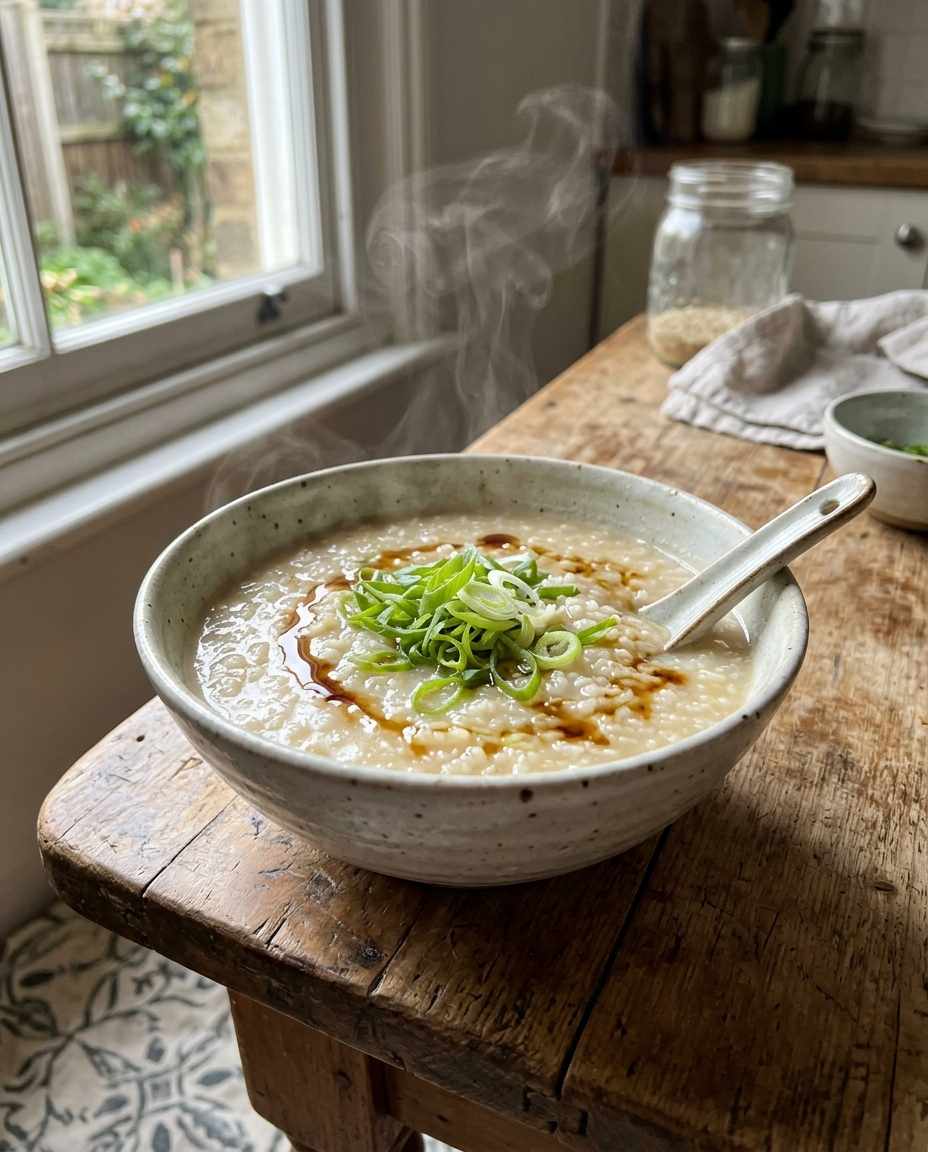
I stood before my favorite heavy-bottomed pot, glancing at the fridge where a container of leftover jasmine rice rested.
Transforming that day-old rice into a luxurious bowl of congee wasn’t just about reheating—it was alchemy.
This guide unpacks the deeply nuanced art of remaking leftover rice into silky, comforting congee that rivals fresh-cooked versions.
Understanding Rice Types for Congee

Not all rice behaves the same when transformed into congee.
Short-grain japonica rice has higher amylopectin content, making it naturally creamier and starchy upon cooking, while long-grain varieties like basmati or jasmine yield a lighter, less sticky texture.
When using leftover rice, the grain’s initial moisture absorption profoundly affects how it rehydrates and breaks down during simmering.
In my experience, leftover jasmine rice often retains its floral aroma but tends to separate more during cooking, necessitating longer simmering or extra water to reach the right porridge consistency.
Sticky or sushi rice, conversely, converts quickly to a velvety texture but risks becoming a gluey mass if overcooked.
The choice impacts texture, flavor release, and mouthfeel.
A common mistake is blindly using whatever rice is leftover without adjusting liquid ratios or cooking time.
For example, using drier basmati rice leftover from a refrigerator requires increased liquid by at least 30% and a longer cooking window of 45 minutes to an hour.
Underestimating the rice’s starch and moisture profile leads to a grainy or mushy final product.
Your takeaway is to identify your leftover rice type before proceeding.
If uncertain, test a small batch with 3 cups water per cup of rice and simmer 30 minutes, adjusting liquid gradually.
Start conservatively and add broth or water incrementally to control thickness and prevent breakup.
This preliminary calibration saves you from texture missteps.
Optimizing Liquid Ratios and Broth Selection
Congee texture depends heavily on liquid volume relative to rice.
Leftover rice, being partially dried and cooled, demands a higher water-to-rice ratio than freshly cooked.
I recommend starting with a 5:1 ratio—five parts water or broth to one part rice by volume.
This difference accounts for the rice’s reduced surface moisture and prevents clumping.
Broth choice is equally critical.
Using homemade bone broth or richly flavored stock infuses umami depth, adding layers not achievable with plain water.
My favorite is a lightly simmered chicken or mushroom broth at 60-70 degrees Celsius, which gently melds with rice starch, producing a subtly thickened porridge that tastes crafted, not just diluted.
A frequent error is beginning with cold water or broth, which prolongs cooking time and prevents starch gelatinization.
Starting with warm broth around 60 degrees helps activate the rice’s starch granules immediately, speeding up cooking and creating a silkier mouthfeel.
Additionally, avoid boiling to prevent broken-down rice from turning gummy and losing structure.
For best results, measure liquid precisely using a heatproof measuring cup and adjust mid-simmer if needed.
Remember, you can always add more broth but cannot remove it once absorbed.
Using a ratio calculator or a kitchen scale (aim for roughly 1200ml liquid for 240g rice) ensures consistency across batches.
Rehydration Techniques for Leftover Grains
Leftover rice often has hardened or dried-out grains due to refrigeration.
Rehydration is the first essential step in creating uniform congee.
I’ve found soaking leftover rice in warm water for 15–20 minutes before cooking dramatically reduces simmering time and prevents grain separation.
The principle behind this is simple: softened grains absorb liquid more evenly, enabling starch to disperse naturally during simmering.
In practice, skipping this leads to uneven texture with bits remaining chewy while others dissolve completely.
This contrast can ruin the smooth congee experience.
One common misconception is that soaking in cold water or overnight is beneficial.
For congee, warm water soaking is preferable as it minimally activates starch but avoids fermentation risks.
Also, avoid soaking for longer than 30 minutes to prevent overhydration that leads to mushiness.
Your actionable step is to place your rice in a bowl with just enough warm water (roughly 40 degrees Celsius) to cover by 2 cm, stir gently once, then leave covered for 20 minutes.
Drain and then proceed to simmer.
This simple routine enhances even starch release and depth of flavor extraction during cooking.
Simmering Methods and Temperature Control

Achieving congee’s perfect creaminess without turning it gloppy depends on controlled simmering with moderate agitation.
When cooking from leftover rice, a lower heat around 80 degrees Celsius is ideal because it facilitates gentle starch gelatinization without aggressively breaking down the grains.
I tested both high and low temperatures and found that boiling at 100 degrees causes the starch molecules to rapidly burst, resulting in lumpy textures and lost viscosity.
Conversely, too low temperatures prolong cooking unnecessarily, risking microbial growth if not watched carefully.
The sweet spot is stable simmering, maintained for 30 to 45 minutes.
Adjusting your heat source matters: use a heavy-bottomed pot or enameled cast iron with a thick 4–5 mm base to distribute heat evenly and prevent burning on the bottom.
Stir occasionally, every 8–10 minutes, to prevent rice from sticking but avoid vigorous stirring which ruptures grains and yields a glue-like slurry.
The takeaway is to invest in a reliable kitchen thermometer or use an induction cooker with preset low-temperature modes.
Set the broth to simmer gently, maintain steady bubbling, and use gentle folding motions to encourage even disintegration while preserving a silky texture.
Enhancing Flavor: Ingredients and Timing
Flavor layering in congee is an art that begins before simmering and continues through final garnish.
Adding aromatics like ginger slices and white peppercorns at the start infuses subtle warmth, while fresh scallions or cilantro added at the end preserve brightness.
Protein, whether century egg, minced pork, or tofu, can be stirred in midway to cook through gently.
I always advise against introducing salt or soy sauce in the beginning because as the rice starch breaks down, it concentrates and can lead to overly salty or sharp tastes.
Instead, season lightly after the congee reaches your preferred consistency.
This phase is about balancing umami with acidity and freshness.
A pitfall is overcrowding the pot with too many strong flavors early on, which masks the delicate creaminess of the base.
The key is restraint: build subtle foundations before layering assertive toppings or sauces such as chili oil or fermented black beans.
To master this, plan your additions in stages: start with broth, rice, and aromatics; halfway through add proteins or mushrooms; finish with seasoning and fresh herbs.
This sequence keeps flavors distinct and elevates each spoonful from comforting to memorable.
Texture Adjustments and Final Consistency

Congee texture is subjective but generally ranges from thick porridge to soup-like liquid.
When using leftover rice, texture adjustments are crucial since the grains are partially cooked and their starches may have slightly retrograded.
If your congee feels too thick or gluey, dilute with hot broth in 100 ml increments to loosen.
Conversely, if it’s watery early on, simmer uncovered to evaporate excess liquid and concentrate flavors.
I once made the mistake of adding cold water mid-cook to stretch the batch; it disrupted the gelatinization process and left the congee grainy.
Always add hot broth or water to maintain cooking temperature and starch breakdown.
If you prefer a completely silky result, blend your congee briefly with an immersion blender for 10 seconds but avoid over-blending, which destroys all grain integrity and feels artificial.
A measured approach preserves that subtle bite and visual appeal.
Measure your congee’s final viscosity by lifting a spoon upright: it should coat behind the spoon in a translucent layer with a slow drip rate under 3 seconds.
Adjust thickness actively during cooking rather than waiting to the end to avoid texture disappointments.
Storage and Reheating Without Texture Loss
Leftover rice congee is popular for leftovers itself, but storage and reheating require precision to avoid grain hardening or a rubbery mouthfeel.
Cool your congee quickly by transferring into shallow airtight containers and refrigerate within 1 hour of cooking to prevent bacterial growth.
When reheating, avoid microwaving cold rice congee directly; it heats unevenly and promotes grain toughening.
Instead, reintroduce the congee into a pot, add 50–100 ml warm broth per serving to loosen, and gently warm on low heat while stirring.
Heating slowly preserves creaminess and reactivates starch gelatinization.
A common mistake is reheating uncovered at high heat, which evaporates liquid and concentrates starch excessively, making congee thick and gluey.
Cover loosely to trap steam and maintain moisture.
If needed, add fragrance with a splash of light soy or drizzle of toasted sesame oil at serving.
For storage duration, consume refrigerated congee within 3 days for peak texture and safety.
Freezing is possible but textures degrade noticeably; if freezing, freeze in individual portions with some broth to protect grain integrity during thawing.
Innovations: Blending Congee with Global Flavors

Congee’s simplicity is a canvas for cuisine fusion.
Using leftover rice allows you to experiment with non-traditional flavors, adding ingredients like coconut milk for a creamy Thai twist or miso for an umami boost that complements the rice base.
I’ve found adding 100 ml coconut milk in the final 10 minutes of simmering creates a silky, subtly sweet congee perfect for breakfast or dessert.
Another innovation is blending congee with Mediterranean flavors by stirring in za’atar or minced preserved lemon, which contrasts congee’s mellow starchiness with herbaceous and bright notes.
This balance refreshes the palate and turns a humble dish into elegant fare.
Avoid overpowering the base with aggressive spices early on; instead, introduce global accents at the end, post-simmer.
This preserves rice texture while infusing flavor.
Also consider texture contrasts like crunchy toasted nuts or fried shallots for enhanced mouthfeel.
Your takeaway is to view leftover rice congee not as a culinary fallback, but as a versatile platform for creativity.
Try small ingredient additions incrementally to find novel combinations that respect congee’s essence yet surprise and delight.




Leave a Reply