
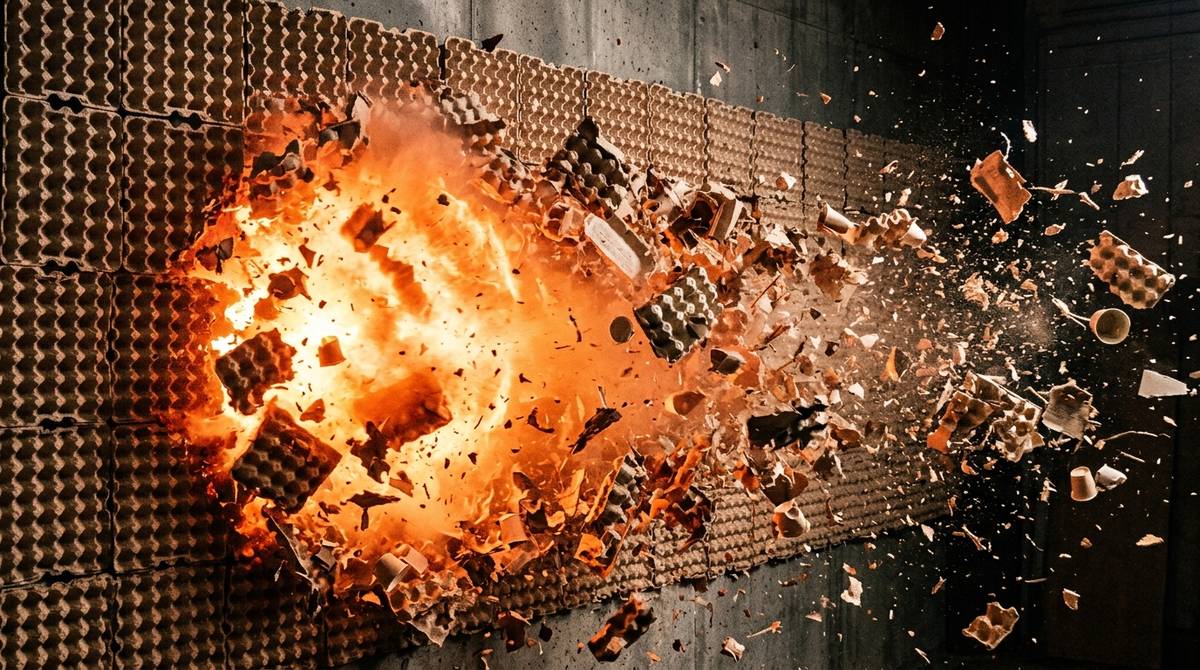
If you have ever researched how to build a budget-friendly home theater, a basement rehearsal space, or a DIY recording studio, you have undoubtedly stumbled across the most famous “life hack” in the world of acoustics: gluing empty cardboard egg cartons to your walls.
The internet is filled with photos of amateur studios completely plastered in gray, recycled egg cartons. The logic seems to make intuitive sense to the untrained eye. After all, the bumpy, geometric shape of an egg carton looks strikingly remarkably similar to the expensive, professional acoustic foam panels you see in million-dollar recording studios and high-end cinemas. Furthermore, it is practically free.
But does this legendary DIY trick actually work? If you want to build a room where you can blast a high-end surround sound system without waking up your family or disturbing your neighbors, will a trip to the local grocery store save you thousands of dollars in construction materials?
The short answer is an absolute, definitive no.
To understand why this myth is so completely flawed, we have to look closely at the physics of sound, the rigorous testing data from architectural acoustic laboratories, and the fundamental difference between sound absorption and sound containment.
Subscribe
Enter your email below to receive updates.
The Crucial Difference: Soundproofing vs. Sound Absorption
The main reason the egg carton myth persists is that most people confuse two entirely different acoustic concepts: sound barriers (soundproofing) and sound absorbers (acoustic treatment). If you are planning a home theater, understanding this distinction is the most important step you can take.
1. Sound Absorbers (Acoustic Treatment) According to acoustic engineering principles, sound absorbers are designed specifically to “reduce the noise due to reflections (echoes or reverberation) within a space”. When you are in an empty room with hardwood floors and bare drywall, your voice echoes. Sound absorbers fix this by catching those internal sound waves and preventing them from bouncing around the room.
These absorbers are “usually some kind of foam, fiberglass, fabric or other ‘fuzzy’ material”. Professional acoustic foam panels and heavy draperies are excellent examples of sound absorbers. They make the audio inside your home theater sound crisp, clear, and focused. However, they are terrible at actually blocking sound from leaving the room. As acoustic experts note, “When used alone, sound absorbers in your home theater will continue to allow sound to be transmitted outside your room to adjacent rooms or even to your neighbors’ homes”.
2. Sound Barriers (Soundproofing) Sound barriers have an entirely different job: they “reduce sound transmission from one space to another”. This is what keeps the 110-decibel (dB) explosions of an action movie from rattling the walls of the bedroom next door.
Traditional sound barriers rely on the “Mass Law, which states that the heavier an object is, the more energy it takes to vibrate it”. For example, “Eight inches of solid concrete is considered an excellent sound barrier”.
Why Egg Cartons Fail Completely
When we evaluate egg cartons through the lens of acoustic science, their failure becomes obvious.
First, consider the Mass Law. Egg cartons are made of incredibly lightweight, thin paper pulp or thin polystyrene. They have virtually zero mass. Because they lack density and weight, they offer absolutely no resistance to the powerful acoustic energy generated by a home theater audio system. When a deep, low-frequency bass wave hits an egg carton, it passes straight through the cardboard, straight through the drywall behind it, straight into the wooden wall studs, and directly into the next room.
But you don’t have to rely purely on theory; acoustic engineers have actually put this DIY myth to the test in accredited laboratories.
There is a widespread, common misconception that lining a wall with egg cartons will miraculously “reduce noise by 10dB”. However, when subjected to rigorous acoustic testing, the results show that egg cartons have “No measurable effect” on sound transmission.
Let that sink in: zero measurable effect. You could spend weeks gluing thousands of egg cartons to every square inch of your home theater, and it will not stop a single decibel of sound from leaking into the rest of your house. Furthermore, because egg cartons are made of hard, pressed paper rather than porous, open-cell foam, they are surprisingly ineffective at even absorbing internal room echoes. Ultimately, covering your walls in egg cartons only achieves one thing: creating a massive, highly flammable fire hazard in your home.
Debunking Other Common DIY Soundproofing Myths
The egg carton hack is not the only misconception that plagues DIY home theater builders. Many people waste thousands of dollars on other traditional “old school” approaches that fail to contain the massive audio output of a modern media room.
If you are trying to increase your wall’s Sound Transmission Class (STC) rating, laboratory test results show that you should avoid these common pitfalls:
- Stuffing the wall cavity with standard fiberglass insulation: Many homeowners believe that packing the space between wooden studs with standard insulation “will fix everything”. In reality, testing reveals that this only provides a minuscule “2-4dB reduction”.
- Adding another layer of standard drywall: The assumption is that doubling up on standard gypsum board will stop deep bass sounds. However, tests prove this only yields a “2-3dB reduction per layer”.
- Using acoustic foam as a barrier: As discussed earlier, foam is strictly an absorber, not a barrier. If you buy expensive acoustic foam thinking it will soundproof the room, you will be disappointed; tests show it is “Ineffective – less than 3dB reduction”.
- Mass-loaded vinyl and soundboards: Putting mass-loaded vinyl beneath drywall is often touted as a miracle cure that will reduce noise by 27dB, but real-world wall tests show it only offers a “3-9dB reduction”. Similarly, using standard soundboard under gypsum only provides “3-6dB of reduction”.
The Real Solution: Viscoelastic Damping
If egg cartons, extra drywall, and fiberglass insulation cannot stop home theater noise, what actually works?
Modern acoustic science dictates that “There are a variety of techniques to reduce noise and vibration in a home theater or media rooms. Most approaches rely on one of two principles: mass or damping”. Because adding enough mass (like 8 inches of solid concrete) is impractical for a standard residential home, acoustic engineers now rely heavily on advanced damping technology.
Instead of recycling breakfast packaging, successful home theaters utilize “advanced technology drywalls and woods designed for superior noise reduction”. These specialized building materials use a “viscoelastic polymer approach with ‘constrained layer damping’ to fundamentally change the way sound moves through walls, ceilings and floors”.
Subscribe
Enter your email below to receive updates.
When you use engineered damped drywall (such as QuietRock) or viscoelastic acoustic glue (such as QuietGlue) during construction, the built-in damping layer “isolates the face of the wall from the studs”. This stops the acoustic vibrations from physically traveling through the wall frame. It acts “as if you built a room-within-a-room, only at a microscopic level”.
Conclusion
Building a high-performance home theater is a major investment, and protecting the peace and quiet of your home is the most important step in the design process. Do not fall victim to the internet’s favorite acoustic myth. Egg cartons will not soundproof your room, they will not improve your audio quality, and laboratory testing proves they offer zero measurable reduction in sound transmission. If you want a truly soundproof room, skip the grocery store life hacks and invest in modern, scientifically proven viscoelastic damping materials.




Leave a Reply