
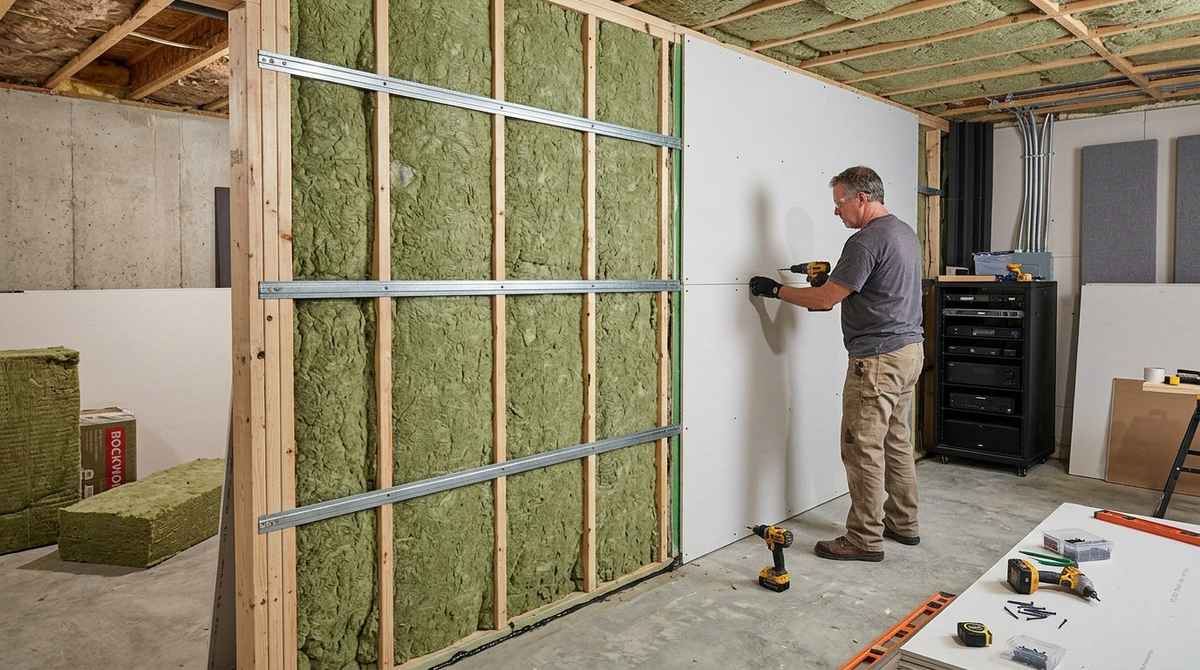
In modern residential construction, the single wood stud wall is the standard for interior partitions. It is cost-effective, relatively quick to build, and structurally sound for supporting everything from cabinetry to artwork. However, when it comes to the extreme acoustic demands of a high-end home theater, this standard construction method is a significant liability. A typical existing wall—consisting of 2×4 wood studs with standard drywall on either side—yields a Sound Transmission Class (STC) rating of only 30 to 34.
If your home theater is producing audio peaks of 110 decibels (dB), an STC 34 wall will allow 76dB of noise to bleed into the adjacent room, creating a sound level comparable to a noisy factory interior. This is far too loud for relaxation or sleep in the rest of the house. While many believe they must build massive double-stud walls to achieve silence, modern technology allows you to engineer a high-performance, soundproof single wood stud wall that can achieve STC ratings in the mid-to-high 50s, which is equivalent to an 80% to 86% perceived reduction in noise.
Here is the comprehensive, step-by-step guide to constructing a soundproof single wood stud wall for your private cinema.
1. The Foundation: Stud Spacing and Framing
The first step in building a superior acoustic wall begins with the frame. In standard construction, studs are often placed 16 inches on center (OC). For better acoustic performance, experts recommend using 24″ OC wood stud framing. Increasing the spacing between the studs reduces the number of rigid mechanical bridges that sound vibrations can use to cross from one side of the wall to the other.
If you are working with an existing 16″ OC wall, you don’t necessarily need to tear it down. You can achieve significant improvements (up to an STC of 58) by retrofitting advanced damping materials over the existing structure.
2. High-Performance Cavity Insulation
While standard thermal fiberglass insulation is a popular “quick fix,” it is notoriously ineffective as a sound barrier, typically providing only a negligible 2-4dB reduction. For a professional build, you must use acoustically optimized insulation, such as Bradford SoundScreen R2.0 batts.
These batts are made from rockwool or specially designed mineral composites that are much denser than standard “pink fluff” thermal insulation. Their primary job is to dampen the resonance within the wall cavity itself, preventing the wall from acting like a hollow drum. In new construction, filling the 24″ OC stud cavity with high-performance acoustic batts is a mandatory step for any wall aiming for an STC above 50.
3. Decoupling: Breaking the Mechanical Bridge
The greatest failure of a single stud wall is that the interior and exterior drywall are physically screwed into the same piece of wood. When sound hits one side, the vibration travels through the stud to the other side. To fix this, you must “decouple” the drywall from the framing.
In single stud construction, this is typically achieved using Resilient Channels (RC) or Resilient Mounts. These metal tracks are attached to the wood studs, and the drywall is then attached to the tracks. The metal acts as a spring, absorbing much of the vibrational energy before it can enter the wooden frame. While this is an older technology, it can still provide a “Good” level of soundproofing when combined with standard materials, though it is prone to being ruined by faulty installation (such as “short-circuiting” the channel with a screw that is too long).

4. Choosing the Right Sheathing: Advanced Damping Panels
The most efficient way to achieve world-class isolation on a single stud wall without using the square footage of a double-stud design is to replace standard gypsum with internally damped acoustic panels like QuietRock.
Standard drywall relies on “Mass Law”—the heavier the wall, the better it stops sound. However, adding layer after layer of standard drywall is highly inefficient, only gaining about 2-3dB per layer. QuietRock uses constrained-layer damping, which chemically converts vibrational acoustic energy into microscopic amounts of heat.
Depending on your budget and goals, you can select from several performance tiers for your single stud wall:
- QuietRock 510: An entry-level panel that can achieve an STC of 47 when applied to one side of a 24″ OC wood frame with R13 insulation.
- QuietRock 525: A 5/8″ panel that delivers STC ratings of 51-55 on single stud walls.
- QuietRock 545THX: The ultimate ceramic-polymer-gypsum composite. Using this on just one side of a single stud wall can push the assembly to an STC of 56 to 58, which is a massive 84-86% perceived noise reduction.
5. The DIY Alternative: The Viscoelastic “Sandwich”
If you are on a strict budget and labor is “free,” you can build a highly effective damped wall using standard drywall and QuietGlue. QuietGlue is a viscoelastic adhesive applied in a random pattern between two layers of 5/8″ drywall.
By creating this “internally damped sandwich” on both sides of a 24″ OC wood stud wall with R13 insulation, you can achieve an STC of 56. This is a popular method for DIY builders because it provides performance similar to pre-manufactured damped panels at a lower material cost, though it requires more time and physical effort to install.
6. Sealing the Leaks: Sealants and Putty
A soundproof wall is only as strong as its weakest point. Sound, like water, will seek out any tiny opening to escape the room. Once your panels are hung (using coarse thread drywall screws for wood studs), you must hermetically seal the perimeter.
- QuietSeal: This acoustical sealant must be applied to every joint between panels, as well as where the panels meet the floor and ceiling. Unlike standard caulk, QuietSeal remains viscoelastic and never fully dries, allowing it to flex with the wall’s vibrations without cracking.
- QuietPutty: Standard electrical junction boxes and outlets are “holes” in your sound barrier. Wrapping these boxes in QuietPutty pads ensures that these necessary penetrations do not ruin the wall’s STC rating.
Performance Summary: Standard vs. Engineered
To put the construction of a single stud wall into perspective, consider these laboratory-tested results for a 24″ OC wood stud wall with R13 insulation:
| Construction Method | STC Rating | % Noise Reduction (Perceived) |
|---|---|---|
| Standard 5/8″ Drywall (Both Sides) | 34 | Baseline |
| QuietRock 510 (One Side) | 47 | 69% |
| QuietRock 525 (One Side) | 51 | 77% |
| QuietGlue Sandwich (Both Sides) | 56 | 84% |
| QuietRock 545THX (One Side) | 56-58 | 84-86% |
Source: Quiet Solution independent laboratory testing.
Conclusion
Building a soundproof single wood stud wall is entirely possible if you move beyond “old school” approaches like egg cartons or standard insulation. By utilizing 24″ OC framing, acoustic rockwool insulation, and viscoelastic damping materials like QuietRock or QuietGlue, you can transform a standard residential partition into a high-performance barrier. Remember that an airtight seal using QuietSeal and QuietPutty is just as critical as the choice of drywall itself. With these methods, you can achieve the isolation needed for a world-class home theater without the need for complex double-stud construction.




Leave a Reply