
When enthusiasts set out to build a dedicated home theater, their ultimate goal is usually to recreate the visceral, full-body experience of a commercial cinema. They want to hear the crisp dialogue of the actors, the sweeping orchestral scores, and, most importantly, the room-shaking impact of explosions, thunder, and action sequences. To achieve this, high-performance home theaters rely on massive subwoofers and advanced digital processing capable of extracting low-frequency content below 100 Hertz (Hz) and building it back up to reach deep, thundering levels of 35Hz or 40Hz.
While this immense low-frequency bass makes for a thrilling movie experience, it creates an absolute nightmare for architectural soundproofing. Keeping high-pitched sounds (like voices or sirens) inside a room is relatively simple. However, stopping the deep, physical rumble of cinematic bass from escaping your theater, vibrating the floorboards, and disturbing your entire household is widely considered the single most difficult aspect of acoustic engineering.
If you are designing a high-end media room, understanding why low-frequency loss (frequencies below 125Hz) is so difficult to achieve is the difference between a successful sanctuary and a room that causes endless noise complaints. Here is a comprehensive, scientific breakdown of the physics of deep bass, the fatal flaw in standard acoustic measurements, and the modern engineering required to stop it.
Subscribe
Enter your email below to receive updates.
The Fatal Flaw of the STC Rating System
To understand why low-frequency bass is so elusive, we must first look at how the construction industry measures soundproofing. For decades, architects, builders, and acoustic material manufacturers have relied on a universal single-number metric called the Sound Transmission Class (STC). The STC rating of a wall or ceiling partition is measured in accredited laboratories using strict ASTM E413 and ASTM E90 standards. In theory, the higher the STC rating, the more sound the wall blocks.
Many homeowners and amateur builders rely entirely on the STC rating when buying materials, assuming that if they build an “STC 50” or “STC 60” wall, their home theater will be perfectly soundproofed. However, acoustic engineers will warn you that the STC measurement system harbors a massive, fundamental blind spot when it comes to home cinema design.
As acoustic experts explicitly note, STC is only a basic method for determining transmission loss, and “the STC measurement method does not include such low frequencies in the final calculation”.
The standardized laboratory STC calculation only factors in noise frequencies from 125Hz up to 4,000Hz. This range is excellent for measuring human speech, television dialogue, dogs barking, or general office noise. But it completely ignores the deep, low-frequency effects (LFE) generated by a home theater subwoofer, which operate forcefully below 125Hz.
Because the STC formula ignores deep bass, a wall can achieve a highly impressive STC rating on paper by successfully blocking midrange and high frequencies, while simultaneously being completely transparent to the deep rumble of an action movie. You could spend thousands of dollars building a wall with a high STC rating, only to find that every time a dinosaur stomps on your projector screen, the 50Hz acoustic wave passes effortlessly through the drywall and shakes the china cabinet in the next room.
The Physics of Low Frequencies and Room Modes
Why does bass behave so differently than higher-pitched sounds? The answer lies in the physics of acoustic wavelengths and the immense kinetic energy they carry.
High-frequency sounds have very short wavelengths and carry relatively little energy. When a high-pitched sound hits a standard piece of drywall or a soft, absorptive material, it is easily blocked or deflected. Low-frequency sounds, however, have incredibly long wavelengths. A 40Hz sound wave is roughly 28 feet long. These massive waves carry immense physical energy, and they do not simply bounce off of walls; they physically crash into them, forcefully vibrating the rigid structures of your home.
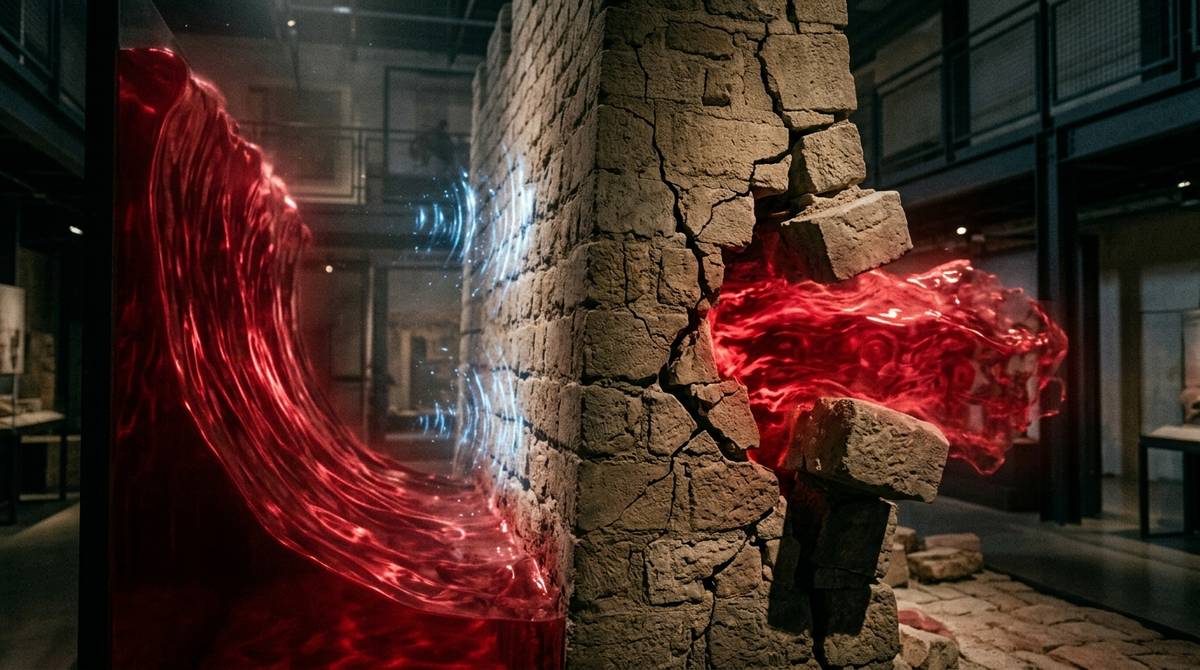
Furthermore, your room’s physical dimensions will create areas of acoustic resonance known as “room modes,” which can significantly accentuate or attenuate bass response depending on where you are sitting or where the sound is hitting the wall. When a subwoofer pushes a 50Hz wave into a standard residential wall, the drywall acts like the skin of a giant drum. It absorbs the massive kinetic impact and transfers that vibration directly into the solid wooden studs of the wall frame. The wood studs then act as a highly efficient mechanical bridge, carrying the low-frequency vibration straight to the drywall on the opposite side of the wall, recreating the booming bass in the adjacent room.
Because low-frequency energy relies heavily on this physical, structural vibration (mechanical coupling), standard residential building materials are entirely defenseless against it.
The Failure of the “Mass Law” Against Bass
When homeowners realize their walls cannot stop subwoofer bass, they often turn to traditional, “old school” soundproofing techniques. Historically, builders relied on the “Mass Law,” which dictates that the heavier and denser an object is, the more energy it takes to cause it to vibrate. While eight inches of solid concrete makes a fantastic sound barrier, adding practical mass to a residential wooden wall frame is highly ineffective against low frequencies.
Because STC is an inadequate metric for bass, acoustic engineers evaluate how a wall handles subwoofers by looking at its “Total Loss (TL) measurements at 1/3rd octave bands down to 50Hz”.
When we look at the Total Loss data at 50Hz, the failure of traditional mass-loading becomes glaringly obvious. A standard single stud wall fitted with Resilient Channels (RC) provides a mere 19 decibels (dB) of loss at 50Hz. To combat this, many DIY builders attempt to add mass by screwing a second layer of standard drywall onto the frame. However, laboratory tests reveal that building a “double gypsum both sides single stud” wall actually worsens the low-frequency performance, dropping the acoustic loss at 50Hz down to a miserable 16dB.
By adding an extra layer of standard, rigid drywall, you do not stop the bass; you simply create a thicker, heavier “drum” that more efficiently transfers the low-frequency vibration directly into the wall studs. Other common methods, such as stuffing the wall cavity with standard fiberglass insulation or adding standard soundboard under the gypsum, also fail to stop this mechanical transfer of low-frequency energy, yielding only negligible decibel reductions.
The Modern Engineering Solution: Viscoelastic Damping
Since the Mass Law fails to stop frequencies below 125Hz in standard residential construction, and because STC ratings are highly misleading for home theaters, how do industry professionals actually contain deep bass? The answer lies in modern acoustic technology: constrained-layer viscoelastic damping.
Instead of relying on heavy, bulky materials, leading acoustic companies have engineered a series of advanced technology drywalls (such as QuietRock) and sub-floor woods (such as QuietWood) that fundamentally change the way sound moves through a structure.
These highly advanced building panels incorporate a viscoelastic polymer layer trapped directly inside the core of the board. Viscoelastic materials possess a unique physical property: when they are struck by the massive kinetic energy of a 50Hz bass wave, they do not simply vibrate and pass the energy to the wall studs. Instead, the polymer layer physically shears and deforms, chemically converting the low-frequency acoustic vibration into a microscopic amount of heat.
By safely dissipating the energy before it can cross the wooden bridge of the wall frame, constrained-layer damping effectively isolates the face of the drywall from the studs themselves. As acoustic engineers describe it, “it is as if you built a room-within-a-room, only at a microscopic level”.
The Total Loss (TL) data for viscoelastic damping at 50Hz proves its superiority over traditional mass. While a double layer of standard gypsum on a single stud wall yields a pathetic 16dB loss at 50Hz, utilizing an engineered damped panel like QuietRock 545THX on both sides of a double stud wall yields a massive 42dB loss at 50Hz. If a builder wants the ultimate protection against high-end subwoofers, installing a double layer of QuietRock 545THX on both sides of a double stud wall achieves a staggering 45dB loss at 50Hz.
By utilizing these modern damping techniques, you can achieve dramatically higher low-frequency containment using less material, less weight, and less architectural bulk than traditional, failure-prone mass-loaded walls.
Subscribe
Enter your email below to receive updates.
Conclusion
Low-frequency loss is the most difficult aspect of theater soundproofing because deep bass waves carry immense kinetic energy that easily bypasses standard construction materials. Compounding the problem, the universally trusted STC rating system completely ignores frequencies below 125Hz, leading many homeowners to build walls that perfectly block dialogue but completely fail to contain the rumble of a subwoofer. To successfully isolate a high-performance home cinema, you must look beyond STC ratings and demand high Total Loss (TL) performance at 50Hz. By abandoning outdated “Mass Law” techniques and utilizing advanced viscoelastic constrained-layer damping, you can successfully decouple your theater, dissipate low-frequency energy, and ensure that your explosive movie soundtracks do not disrupt the rest of your home.




Leave a Reply