
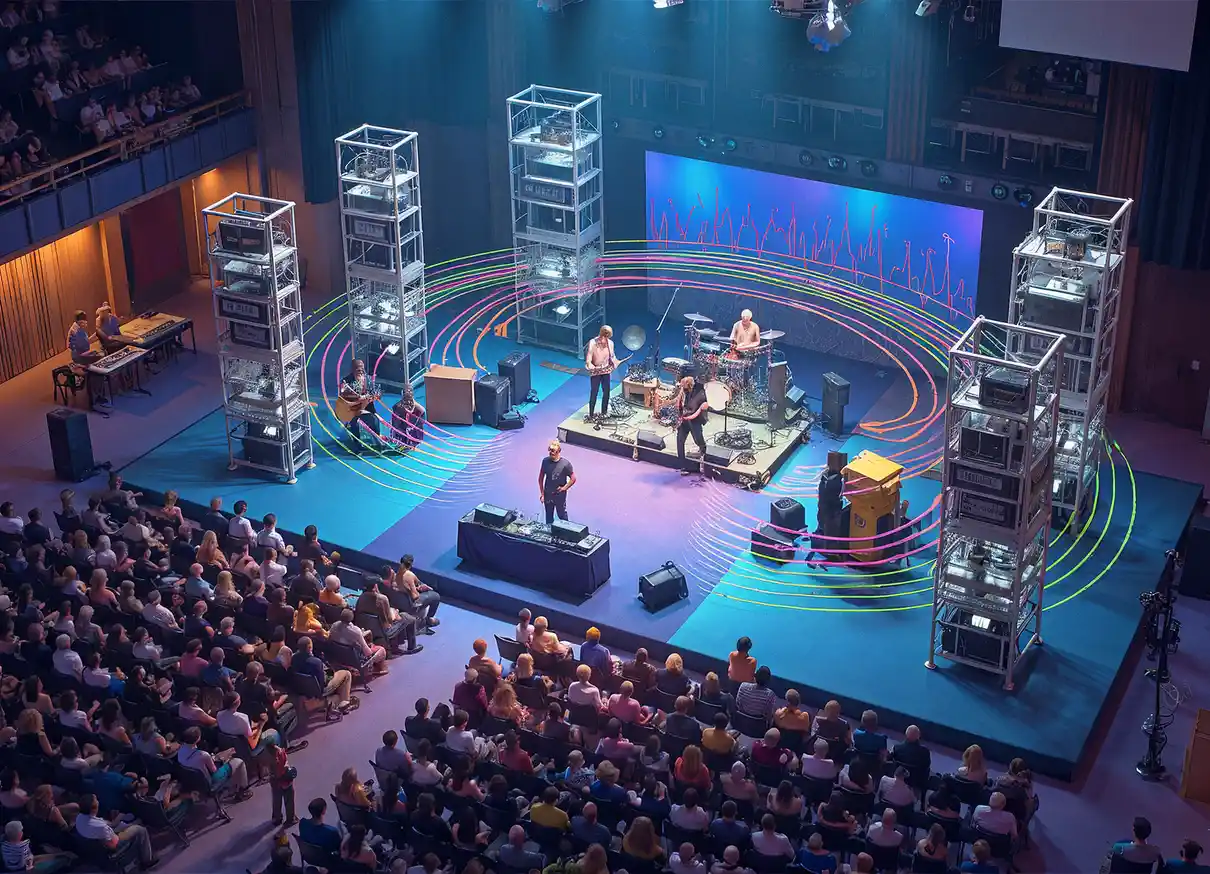
London, March 2025 – As concert-goers seek ever more immersive experiences, spatial audio technology is making its way from studios and cinemas onto the live music stage. The concept – creating three-dimensional, 360° sound environments – is being tested at festivals and shows, prompting the question: Is spatial audio the future of live music events? Recent developments suggest the industry is leaning yes.
This spring, London will host what’s billed as the first spatial audio music festival in the UK, where an entire stage is dedicated to an immersive 3D sound experience.
A prime example is the upcoming Polygon Live LDN festival, which is constructing enclosed 360° “audio domes” rigged with an array of over 100 speakers surrounding the audience.
Subscribe
Enter your email below to receive updates.
These hemispherical venues – essentially portable sound chambers – allow live sets to be mixed in full 360-degree audio, so attendees hear music moving around them in real time.
“It’s like a cocoon of sound, putting the listener at the center of music moving around you from all angles,” explains Polygon, the company pioneering this setup.
Their sound engineers work with performing DJs and artists to choreograph the movement of sound, using specialized hardware and software to pan elements (a vocal, a synth, a drum hit) overhead or behind the crowd.
The result is an almost otherworldly experience – “a vortex… another dimension” is how Polygon describes it – that goes beyond what standard stereo PA systems deliver.
Spatial audio has until now been rare at concerts, found only at select venues like the high-tech Sphere in Las Vegas or bespoke art installations.
But 2025 seems to mark a turning point. Polygon’s London event in May aims to “pave the way for the future of live events”, showing that large-scale outdoor spatial audio is feasible.
The company believes immersive sound can exist “beyond headphones. Beyond controlled environments. To fields and festivals. To dance floors and arenas,” as its mission statement proclaims.
Attendees in the dome will not only hear music swirl around; synchronized 360° lighting and even scent dispersal will heighten the multi-sensory immersion.
Prominent audio manufacturers are also investing in live spatial audio. Companies like L-Acoustics (with its L-ISA system) and d&b audiotechnik (Soundscape) offer speaker setups and software that allow event producers to position sound in 3D space.
Early adopters, such as electronic artist Boys Noize who performed a “surround sound” DJ set at a festival, have received rave reviews from fans who felt inside the music.
There are challenges – costs are higher and mixing in 3D requires new skills – but the technology is advancing quickly.
Industry experts at the recent Sónar+D conference noted that spatial audio is “set to become a standard in audio production, redefining the future of sound”.
Subscribe
Enter your email below to receive updates.
For live music, that could mean concerts where the audio is as dynamic as the light show – an interactive soundscape tailored to each venue.
As one festival organizer put it: “Compelling sound can come from anywhere”.
If upcoming showcases like Polygon Live succeed, spatial audio may move from niche experiment to mainstream live events, enriching how we collectively experience music in the coming years.



Leave a Reply