
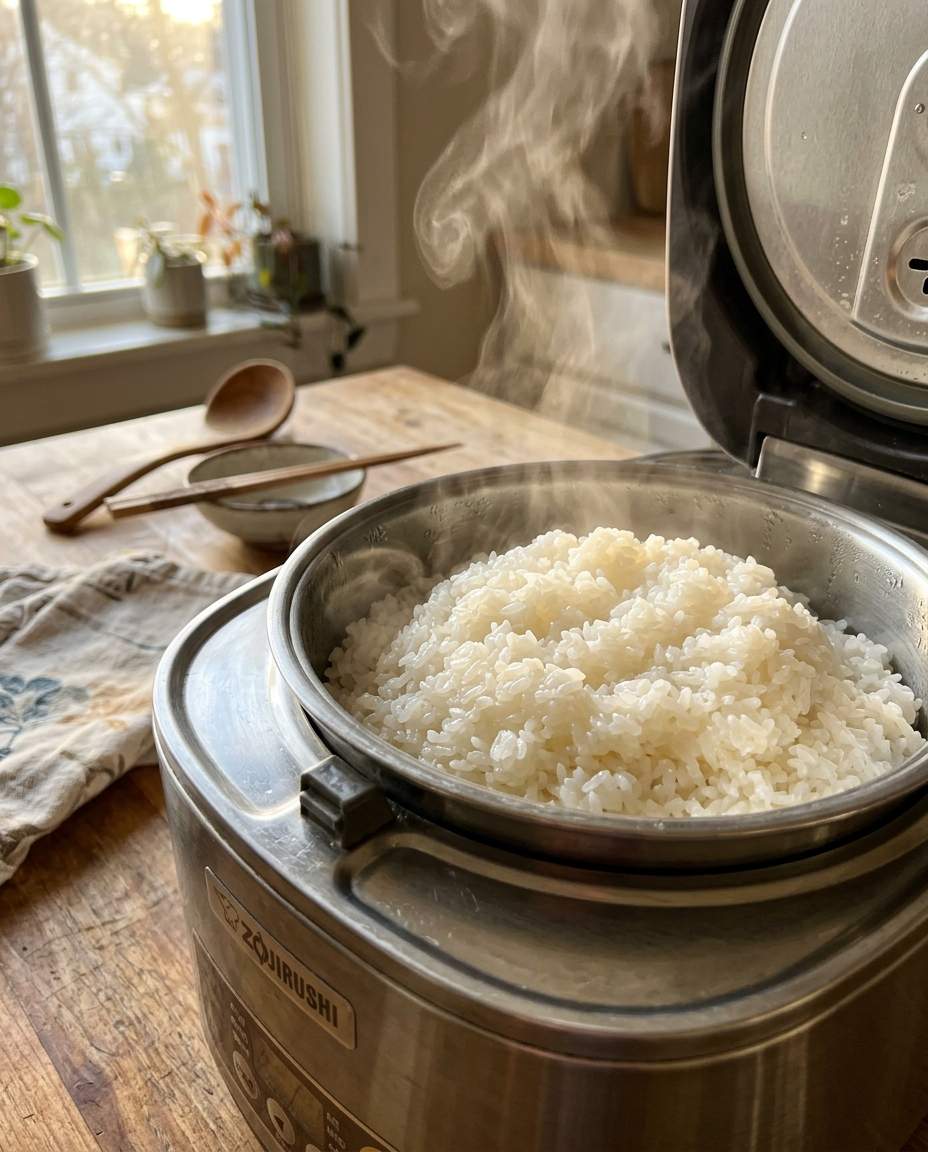
The first time I lifted the lid after a 30-minute steam cycle, a cloud of fragrant, perfectly tender Calrose rice billowed out, each grain glossy yet distinct.
Achieving that flawless balance between stickiness and fluffiness in a rice cooker takes more than tossing in water and pressing start.
This guide delivers insider wisdom, scientific precision, and hands-on techniques to master Calrose rice every time.
Understanding Calrose Rice Characteristics
Calrose rice, a medium-grain variety developed in California, uniquely balances starch content to deliver its signature sticky yet fluffy texture.
Its amylopectin percentage hovers around 20-25%, higher than long-grain varieties but lower than sushi rice, which directly influences cooking behavior and water absorption rates.
For context, this starch composition is responsible for its slightly clumpy texture, perfect for dishes like bibimbap and fried rice.
I once tried cooking Calrose with the same water ratio I use for jasmine rice, a common novice error.
The result was a gummy, overcooked mess because jasmine rice typically requires less water.
Understanding that Calrose needs a higher water ratio, often 1:1.25 to 1:1.5 (rice to water), is essential to prevent undercooked centers or overly sticky clumps.
The grain size and shape of Calrose,shorter and plumper than basmati,also affect its cooking time and technique.
Because it absorbs water relatively quickly, timing and water temperature before cooking become crucial factors.
For example, pre-soaking for 15-30 minutes at room temperature can standardize moisture levels, ensuring more consistent texture.
To nail perfect Calrose rice, focus on these key intrinsic factors: its starch profile, water absorption characteristics, and grain morphology.
By tailoring your cooking process to these native properties instead of applying generic rice cooking rules, you gain control to create a precise texture profile catering to your preferred style.
Rice Cooker Types and Their Impact

Not all rice cookers are created equal when it comes to preparing Calrose rice, and choosing the right type influences outcome significantly.
Basic electric cookers provide heating from a single bottom plate, often resulting in uneven cooking or scorching.
Superior models use fuzzy logic microprocessors that monitor temperature changes and adjust cooking parameters dynamically, preventing under or overcooking.
I initially used a standard 3-cup capacity cooker with a non-stick Teflon inner pot.
It produced inconsistent results; some batches had dense patches while others were mushy.
After switching to a 5.5-cup rice cooker equipped with a thick, 3-millimeter hard-anodized aluminum inner pot, the heating was more uniform, reflecting in the evenly cooked grains.
Advanced rice cookers introduce induction heating (IH) technology which offers multi-directional heating and precise temperature control.
In IH cookers, the inner pot itself becomes a heating element, allowing temperatures to rise quickly and maintain steady heat , ideal for the delicate balance Calrose demands.
The trade-off is cost and larger footprint, but the payoff in texture quality is tangible.
When selecting a cooker, pay attention to the inner pot material (hard-anodized aluminum or stainless steel with nonstick coating), heating method (conduction vs induction), and control features (fuzzy logic algorithms, preset programs).
These influence thermal distribution and moisture retention, both fundamentally affecting Calrose rice perfection.
Mastering Water Ratios and Soaking
Water ratio is the single most crucial variable in cooking Calrose rice because it dictates starch gelatinization and final texture.
Unlike long-grain rice that thrives on a 1:1 water-to-rice ratio, Calrose typically requires about 1.25 to 1.5 cups of water per cup of rice.
This compensates for its higher amylopectin content which demands more hydration to soften fully without becoming gluey.
I experimented with water ratios ranging from 1.1 up to 1.6 cups of water for each cup of Calrose, noting that below 1.2, the grains remained undercooked with a chalky core, while above 1.5, the rice lost structure and became overly sticky.
Tracking moisture content changes visually and tactilely helped refine my personal preference to 1.35 cups, balancing chew and cohesion perfectly.
Soaking Calrose rice for 20-30 minutes prior to cooking allows grains to swell uniformly and reduces overall cooking time by 10-15%.
This hydration equilibrium stabilizes final texture, especially beneficial in drier climates or for rice stored long-term.
Avoid soaking longer than an hour to prevent grain damage and excess starch leaching which can cause stickiness beyond desirable limits.
For practical precision, always measure rice and water by volume using a clear, graduated measuring cup, and give the rice a gentle rinse before soaking to remove surface starch.
This prevents clumping and forces you to maintain consistent hydration, critical for repeatable, perfect results.
Temperature Control and Cooking Phases
Cooking perfect Calrose rice involves understanding the three key temperature phases: initial heating, simmer, and keep-warm.
Each phase triggers starch gelatinization and moisture absorption differently, and rice cookers with fuzzy logic or induction heating systems modulate these precisely for optimal results.
When I first activated the rice cooker, it quickly moved through the initial heating phase at about 80°C to 90°C, gradually raising until it reached the simmer point near 100°C.
This causes starch granules in Calrose rice, rich in amylopectin, to swell and burst uniformly without breaking apart, lending that signature tender but intact grain.
Common mistakes come from machines either accelerating too rapidly or cutting power prematurely, resulting in undercooked, dry rice or overcooked, mushy clumps.
Counterintuitively, maintaining a slightly lower simmer temperature for a few minutes longer than usual enhances water penetration and completes gelatinization evenly.
Your cooker’s rice type settings or manual overrides can facilitate this control.
The keep-warm phase held at a steady 65°C to 70°C is not mere holding but subtle drying.
Leaving rice here for 10 to 15 minutes post-cooking evaporates excess surface moisture, preventing sogginess and improving fluffiness.
For Calrose, this phase is critical given its moisture-loving nature.
Rinsing and Post-Cooking Techniques

The rinsing step before cooking Calrose rice often generates debate, but its impact on texture is profound.
Rinsing removes surface starch which otherwise collects during cooking and causes excessive clumping or gummy textures.
I learned that three gentle rinses in cool water until the runoff is nearly clear yields optimum starch removal without washing away minerals.
Many beginners skip rinsing or over-rinse under fast water streams that damage fragile grains, leading to broken rice and sticky, uneven clumps.
A consistent practice is submerging the rice, gently swirling with fingers, and gradually pouring water off , repeat this process twice more for best results.
After cooking, I often fluff Calrose rice with a wide, flat paddle made of bamboo or silicone to separate grains.
Pressing or over-stirring compresses starches and negates the effects of careful cooking.
Fluffing encourages steam evaporation, further enhancing texture and preventing the ‘damp bottom layer’ phenomenon.
In certain recipes, lightly misting steamed rice with room temperature filtered water before fluffing can restore hydration uniformity if the rice has dried unevenly.
This advanced technique comes from Japanese rice masters and is particularly useful when rice sit times before serving exceed 20 minutes.
Advanced Rice Cooker Settings for Calrose
Many rice cookers feature adjustable settings for rice type, texture preference, and soak time to better accommodate varieties like Calrose.
I found that selecting the ‘medium’ or ‘sticky’ rice mode, if available, tailored the cooking algorithm to raise water absorption gently without oversaturation.
This contrasts with ‘white rice’ presets tuned more for long grains.
Custom soak timers in programmable cookers are invaluable.
Calrose’s ideal 20-30 minute soak can be set with precision, ensuring consistent hydration cycles regardless of ambient temperature or batch size.
Skipping or underestimating soak time is a frequent mistake for busy cooks relying solely on default cook times.
Some premium rice cookers offer ‘fuzzy logic’ adjustments that tweak temperature and timing in 5–10 second intervals based on sensed moisture and heat profiles.
This delivers results that mimic expert chef intuition but requires manual observations initially to calibrate your ideal final texture region.
If your cooker lacks such features, you can simulate them through manual water adjustments and post-cooking resting times.
Experiment with small volume batches,around 2 cups,to observe precise moisture and texture effects before scaling to family-sized quantities.
Troubleshooting Common Calrose Rice Problems

Overcooked, gummy Calrose rice is usually a symptom of too much water or cooking temperature being too high too early.
One time I left the rice cooking on a faulty cooker that never cycled down from the initial boil phase and ended with a gluey, near-paste texture.
Always double-check cookers are cycling properly and measure water precisely.
Conversely, dry, hard grains indicate either insufficient water, a cooker that shuts off prematurely, or rice that was not soaked adequately.
I encountered this after trying to reduce cooking time by lowering water input,an error that cost me an entire batch.
Revert to manufacturer’s water ratios and soak habits before deviating.
Uneven texture, where the bottom layer is mushy but top grains are dry, often signals poor heat distribution inside the inner pot or elevation changes that affect boiling dynamics.
Hard-anodized pots with thick aluminum bases minimize this problem.
If unavailable, stirring the rice gently during mid-cooking (if your cooker supports it) can equalize heat exposure safely.
For perfect Calrose, address these issues systematically: confirm water ratio, confirm cooker cycling behavior, assess rice freshness (aged rice needs more water), and consider pot materials.
Document your settings each time so troubleshooting becomes data-driven rather than guesswork.
Calrose Rice Serving and Storage Tips
Serving Calrose rice immediately after fluffing preserves its ideal texture and aroma.
I discovered that letting rice sit exposed to air for more than 20 minutes causes it to dry out and harden on the surface, negatively impacting mouthfeel.
Keep rice covered loosely with a clean cotton cloth to retain moisture without condensation buildup.
For leftovers, cool rice quickly by spreading on shallow trays and refrigerate within 30 minutes to prevent bacterial growth and texture degradation.
When reheating, introduce a tablespoon of water per cup of rice and cover to create steam, restoring fluffiness.
Microwave reheating without moisture addition often results in dry, crumbly grains.
Freezing Calrose rice is feasible but demands portioning into airtight containers to minimize freezer burn and prevent grain hardening.
Thaw in the fridge overnight, and reheat using the steaming method to maintain structure.
I use silicone molds to freeze individual servings, simplifying meal prep while retaining texture quality.
Understanding the starch behavior during cooling is vital,the retrogradation process causes starch molecules to crystallize, firm up, and become less digestible.
Reheating with steam partially reverses this but multiple freeze-thaw cycles hasten grain deterioration.
Consume within 3 days for optimal taste and safety.


Leave a Reply