
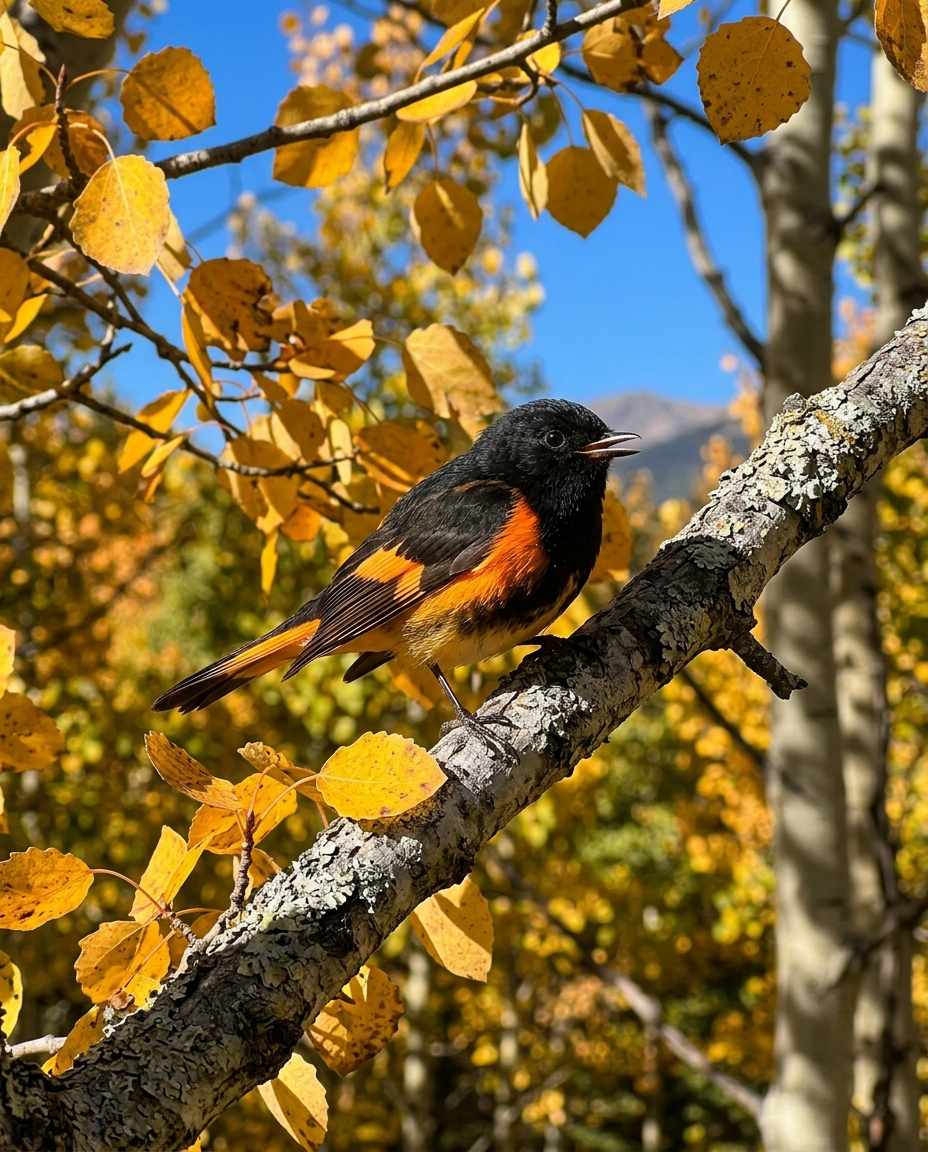
One crisp autumn morning near Boulder, I spotted a brilliant flash of orange and black darting among the aspens.
Its vivid plumage contrasted sharply with the gold leaves and deep blue sky, sparking my curiosity about Colorado’s boldest color combos in birds.
This article uncovers the biology, behavior, and habitat of these striking species to deepen your connection with Colorado’s avian palette.
Key Species Sporting Orange and Black Plumage
Colorado’s ecosystems host several iconic orange-and-black birds, each with distinct adaptations.
The Bullock’s Oriole, recognizable by its fiery orange body and deep black face mask, thrives in riparian woodlands.
The varied Blackburnian Warbler, sporting a striking orange throat and black-and-white wings, visits spruce-fir forests during migration.
Their coloration is not merely aesthetic; these hues function in species recognition and sexual selection.
I once mistook a Bullock’s Oriole for a Western Tanager on a brief glimpse because their orange shades overlap, illustrating the importance of spotting pattern differences such as the Orioles’ solid black hood and white wing bars.
Beginners often confuse these, missing subtle points like tail length or bill shape, which are critical for accurate ID.
To avoid this, always carry a spotting scope or binoculars with at least 8x magnification.
Additionally, juvenile birds often show duller or patchier plumage making identification tricky.
For instance, young Bullock’s Orioles lack the full black face overlay found in adults, increasing misidentification risk.
I recommend using seasonal field guides or apps that include juvenile plumages and calling notes to assist with reliable classification when birdwatching from mid-summer through fall.
In practice, knowing these species enables birders to anticipate their preferred habitats and behaviors.
Both species particularly favor areas near water and avoid open grasslands, so focusing efforts on shaded riparian corridors or mature forests will yield more sightings.
Integrating this ecological preference with detailed plumage knowledge transforms casual viewing into expert-level identification.
The Role of Coloration in Behavior and Survival

The orange and black coloration in Colorado’s birds plays multifaceted roles beyond mere beauty.
These hues serve as signals in mating rituals; the intensity of the orange often directly correlates with the male’s health and fitness.
For example, a Bullock’s Oriole with a rich, saturated orange indicates high carotenoid intake, making it more attractive to females.
During territorial disputes, bold contrasting colors enhance visibility among dense foliage.
I observed a Blackburnian Warbler aggressively defending a patch of spruce from rivals; its vivid orange throat and stark black pattern broadcast strength and dominance.
The high contrast prevents confusion amid complex forest light patterns.
Without these visual cues, birds risk increased conflict or wasted energy on weaker displays.
However, bright coloration also raises predation risks as it stands out to hunters such as hawks.
These species balance this trade-off by selecting habitats with dense cover or active behaviors like rapid darting flights that reduce exposure time.
Juveniles often sport muted colors to reduce visibility until they can adequately evade predators.
In designing bird-friendly habitats or when birdwatching, understanding these dynamics helps predict where and when birds will be most visible.
You’ll want to focus on early morning or late afternoon when light angles enhance color vibrancy but predators are less active.
This strategy increases both observation success and appreciation for the ecological logic behind these striking patterns.
Habitat Preferences and Seasonal Movements
Orange-and-black birds in Colorado exhibit distinct habitat preferences influenced by their survival needs and life cycles.
Bullock’s Orioles favor open woodlands with cottonwoods and willows near streams during breeding season.
In contrast, Blackburnian Warblers are transient visitors in high-elevation spruce-fir forests during spring and fall migrations.
I tracked a Bullock’s Oriole pair nesting along the South Platte River and noted that the nearby water availability correlated with abundant caterpillars and fruit, critical to the orioles’ diet.
These habitats must also support nesting materials like fibers and spider silk for their signature hanging nests.
Neglecting riparian corridor conservation risks rapid population declines due to habitat fragmentation.
Seasonal altitude shifts are particularly important.
Blackburnian Warblers breed in boreal forests but pass through Colorado’s montane zones briefly, relying on insect swarms on flowering trees.
Birders often miss this window, mistaking absence for local rarity.
Understanding these temporal patterns requires consulting migration tracking resources, such as eBird’s live maps or Colorado Parks and Wildlife alerts.
When designing bird-friendly gardens or parks, replicating these preferred plants,native willows, cottonwoods, and conifers,supports their seasonal and reproductive needs.
Moreover, maintaining uninterrupted habitat corridors enables safe passage during migration, which is vital for species facing increasing climate pressures.
Feeding Ecology and Diet Specifics
Understanding what orange and black birds eat provides insight into their behaviors and habitat choices.
Bullock’s Orioles primarily consume caterpillars, beetles, and ripe fruits such as mulberries and elderberries.
This diet places them as both insectivores and frugivores, influencing their foraging strategies and seasonal movements.
I documented orioles gleaning insects carefully from leaf undersides, exploiting microhabitats often overlooked by less specialized feeders.
Their pointed bills are optimized for such dexterity.
A common mistake new birdwatchers make is assuming these birds feed solely on nectar due to their vibrant coloration.
Recognizing their insectivorous habits will guide you to shrub layers and fruiting trees, increasing observation success.
Blackburnian Warblers, on the other hand, predominantly consume small flying insects like midges and gnats captured high in the canopy.
Their rapid, fluttering captures and sallying flights require open overhead space.
This differs substantially from the more deliberate gleaning of orioles, emphasizing niche specialization even among similarly colored birds.
When supplementing local habitats to attract these birds, planting native berry-producing shrubs like chokecherry and serviceberry alongside insect-attracting flowers or limiting pesticide use promotes healthy food webs.
This, in turn, ensures reliable food sources throughout breeding and migration, sustaining vibrant populations.
Nesting Habits and Reproductive Strategies

Orange-and-black birds in Colorado display fascinating nesting behaviors adapted to their environments.
Bullock’s Orioles construct elaborate hanging nests suspended from outer tree branches, made of fibers, grasses, and spider webs.
Such nest placement reduces predation risks by being out of reach of most ground predators and camouflaged among foliage.
I once observed a nest inspection during fledging season; the craftsmanship was astonishing,fine woven fibers creating a delicate yet durable cradle.
One common oversight in backyard habitat design is planting trees without considering branch structure suitability for these pendulous nests.
Young or small trees without drooping outer branches will not attract orioles despite nearby food availability.
Blackburnian Warblers prefer more concealed cup nests built high in dense conifers.
The female alone tends the nest for roughly 12 days incubation, requiring minimal disturbance.
Timing your birdwatching visits outside of this window respects nesting success.
Overenthusiastic approach can cause desertion, so maintaining a minimum 25-foot viewing distance is advisable.
To promote breeding success, ensure diverse vertical forest structure and maintain native plant species.
Avoid introducing non-native plants that lack appropriate nesting materials or encourage invasive predators such as non-native squirrels that may disrupt nests.
Conservation Challenges and Human Impacts
Despite their vibrant appearance, orange-and-black birds in Colorado face increasing conservation challenges.
Habitat loss due to urban development and agriculture fragments riparian zones critical for Bullock’s Orioles.
Diminished water quality and reduced insect diversity further exacerbate stress on these populations.
I have witnessed local declines near expanding suburban areas where native vegetation gave way to pavement, disrupting food and nesting sites.
Birders must recognize how seemingly small landscape changes can cause cumulative impacts over time.
A frequent mistake is assuming birds will easily relocate rather than crumble under rapid habitat shifts.
Climate change also alters migration timing and food availability, especially for transient species like Blackburnian Warblers.
Phenological mismatches between insect emergence and bird arrival create food shortages, affecting reproductive success.
Conservation efforts must incorporate adaptive management strategies that monitor these temporal dynamics closely.
On a practical level, supporting local conservation organizations, planting native flora, minimizing pesticide use, and advocating for protected riparian corridors are actionable steps everyone can contribute to preserve these spectacular citizens of Colorado’s skies.
Advanced Birdwatching Techniques for Orange and Black Birds

For serious birders targeting orange and black species in Colorado, specialized techniques improve detection and identification accuracy.
Using high-quality binoculars with wide fields of view, such as 8×42 or 10×42 models with ED glass, allows clearer views in varying light.
Incorporating a spotting scope enhances documentation, especially for subtle plumage differences at distance.
I experimented with dawn surveys versus midday visits and found that early morning yielded more active behavior and better lighting for color appreciation, crucial for differentiating species with overlapping color palettes.
Avoiding direct midday sun reduces harsh shadows that can obscure critical markings.
Audio playback of species-specific calls helps in drawing birds closer but requires careful ethical consideration to avoid stress during sensitive breeding periods.
I limit use strictly to non-nesting edges and always keep volume low.
It is common to misuse playback, causing unintended harm; respect and restraint are essential.
Finally, integrating GPS tagging apps and online citizen science platforms like eBird not only records sightings but also builds data that supports long-term research.
A systematic approach combining optics, timing, sound cues, and digital tracking maximizes both enjoyment and scientific value.
DIY Habitat Enhancement for Orange and Black Birds
Creating backyard or community habitats for orange-and-black birds requires thoughtful plant and structure choices.
Focus on native trees like cottonwoods, willows, chokecherries, and serviceberry to provide food and nesting sites.
Incorporate layered vegetation with shrubs and tall grasses to mimic natural riparian edges.
I once transformed a small urban lot by planting clusters of these species and installing hanging nesting structures modeled on Bullock’s Oriole nests using biodegradable fibers.
Within two seasons, orioles were regular visitors.
The key was replicating natural microhabitats rather than generic shelter boxes, addressing species-specific preferences.
Avoid pesticides and herbicides to maintain insect populations essential for feeding, and include water features like dripping fountains or shallow birdbaths with gentle flow to attract them safely.
In my experience, static water is less favored due to mosquito larvae and contamination risks.
Monitoring plant health and adjusting seasonal watering is crucial since drought conditions in Colorado can stress these plant communities.
Use soil moisture sensors with thresholds around 15-20% volumetric water content to maintain optimal hydration, encouraging sustained bird use year-round.


Leave a Reply