
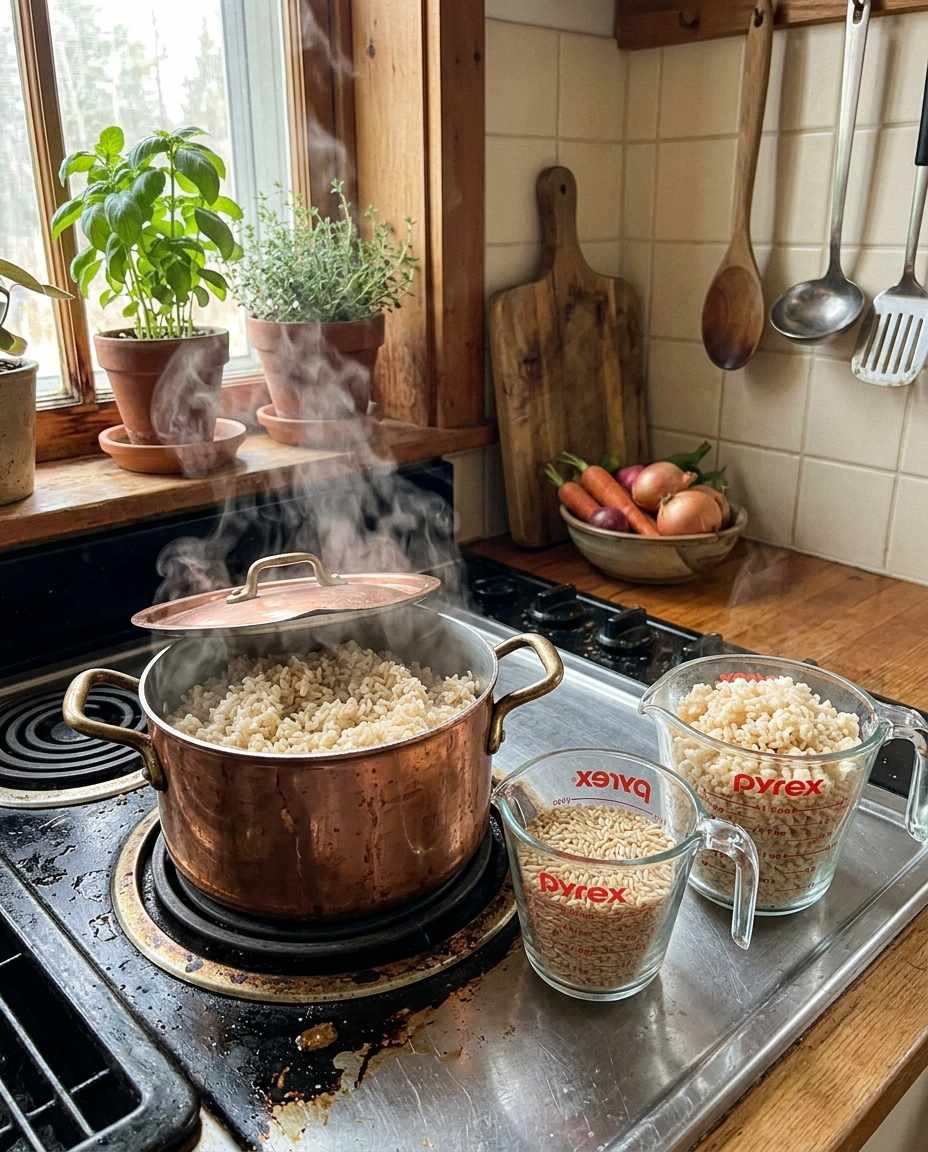
I remember the first time I misjudged how much brown rice would expand mid-cook, ending up with a pot brimming over and chewy grains.
Mastering brown rice expansion is not just a matter of volume but texture, water absorption, and timing.
This guide unlocks everything you need to perfectly predict and control your brown rice outcome.
Understanding Brown Rice Expansion Ratios
Brown rice typically expands to about two to 2.5 times its original volume when cooked.
This means if you start with one cup of raw brown rice, you can expect approximately two to two and a half cups of cooked rice.
The expansion depends largely on the rice variety, with long-grain brown rice expanding more than short-grain types due to kernel shape and amylose content.
The underlying mechanism is water absorption into the bran layer and endosperm, causing starch granules to gelatinize and swell.
For example, short-grain brown rice can take longer to fully hydrate, often expanding less uniformly.
Many home cooks mistake dry weight proportions for volume, leading to miscalculations in serving size.
During an early attempt, I used a half-cup measure for raw rice but did not account for the near tripling of volume after cooking, resulting in a dish too large for my family meal.
The common pitfall is ignoring the expansion factor when scaling recipes, which can lead to over- or under-cooked results.
To get precise results, measure your raw brown rice with a standard dry measuring cup and expect about 2.3x final volume.
If you require finer control, use a kitchen scale and understand that roughly 1 cup (195 grams) of dry brown rice yields around 450 grams cooked.
This precision ensures better portion control and recipe success.
Water Ratios and Their Impact on Expansion

Water to rice ratios critically influence how much brown rice expands and its final texture.
The standard ratio for brown rice is 2.5 cups of water per 1 cup of rice, but this varies by cooking method and rice quality.
Brown rice needs more water than white rice due to its fibrous bran layer, which slows water penetration.
If you add too little water, the rice will absorb all the liquid before the grains fully expand, leading to undercooked, hard kernels.
Conversely, an excess of water can result in mushy rice with swollen but broken grains.
In my culinary experiments, I found that a slight increase from 2.5 to 2.75 cups of water improved tenderness without sacrificing fluffiness.
One common error is following general rice instructions that assume polished white rice, causing home cooks to misjudge brown rice hydration needs.
Another subtle consideration is water temperature; using boiling water shortens cooking time and promotes better expansion compared to cold-start methods.
To fine-tune, begin with a 2.5:1 ratio but adjust by 0.1 increments based on your rice brand and altitude.
Document your water volumes and cooking times to build personal benchmarks.
This approach prevents waste and maximizes texture control.
Soaking Brown Rice Before Cooking
Soaking brown rice for 30 minutes to several hours before cooking alters expansion by pre-hydrating the bran and reducing cooking time.
Soaking initiates water absorption, softening the bran, which otherwise restricts water penetration during cooking.
This results in more uniformly expanded grains and a fluffier texture.
In my kitchen trials, soaked brown rice expanded closer to 2.8 times its original volume compared to the usual 2 to 2.5 times unsoaked.
This benefit is especially noticeable with aged or harder rice, which tends to resist hydration.
Soaking also improves digestibility by activating phytase enzymes that break down phytic acid.
A typical misstep is skipping soaking entirely based on convenience, which compromises the rice’s texture and increases cooking time up to 50 percent.
Conversely, soaking too long (beyond 12 hours) can make grains too waterlogged, leading to overly soft or sticky results.
For optimal expansion, rinse your brown rice thoroughly, then soak for 45 minutes to 2 hours before draining and cooking with a slightly reduced water volume (~2.25:1).
This method balances hydration without losing structure, giving you tender, voluminous rice.
Cooking Methods and Their Effect on Expansion
Different cooking methods influence how brown rice expands by altering water contact, heat distribution, and cooking time.
The stovetop absorption method, where rice simmers in measured water until full absorption, is the most common and yields reliable expansion ratios.
In contrast, boiling then draining often leads to underestimation of volume due to water loss.
A rice cooker uses precise temperature controls and sealed environments to optimize expansion, often producing fluffier rice with a slightly higher volume increase.
Pressure cooking brown rice greatly reduces cook time but results in more compact, stickier grains due to high-pressure gelatinization.
One challenge I encountered with an Instant Pot was predicting volume increase, as steam venting slightly reduces water retention.
Users may over- or underfill to avoid messes or dense rice.
Meanwhile, baking brown rice in a sealed casserole with broth can promote even expansion but requires careful timing and liquid adjustment.
The takeaway is to choose a cooking method fitting your texture preference and kitchen equipment, adjusting water ratios accordingly.
For stovetop, maintain a 2.5:1 water-to-rice ratio; rice cookers usually recommend 1.75:1; pressure cookers work best at 1.25:1.
Always test and adapt your ratios with your device.
The Role of Rice Variety and Age

The variety and age of brown rice critically dictate how much it expands during cooking.
Long-grain varieties, like American long-grain brown rice, expand more sharply and tend to stay separate.
Short- and medium-grain types have more amylopectin, resulting in softer, stickier rice with slightly less volume gain.
Stale or aged brown rice absorbs water differently due to changes in starch crystallinity over time.
Freshly milled rice may swell more but require longer cooking for even expansion.
In contrast, older rice can paradoxically absorb less water, leading to denser cooked grains if not soaked properly.
A mistake I often see is applying a universal cooking ratio across all rice types.
For example, sushi brown rice needs less water and cooks faster than heavier, nutty varieties like Himalayan red rice, which may swell up to three times but require extensive soaking and slow simmering.
To ensure consistent expansion, identify your rice variety and note packaging dates, aiming to cook rice within six months of milling for optimal hydration.
Adjust your water ratio by variety: a general rule is 2.5:1 for long-grain, 2.25:1 for medium, and 3.0:1 or more for harder heirloom varieties.
Measuring Cooked Rice Accurately
Measuring cooked brown rice correctly is vital to recipe success and portion control because raw volume measurements do not translate linearly.
Because brown rice expands 2 to 2.5 times, using first-cooked weight or volume ensures you neither waste food nor underserve.
In my professional kitchen, I use a kitchen scale rather than cups after cooking, weighing about 195 grams per dry cup and around 450 grams when cooked.
Measuring by weight removes air pockets and inconsistent packing in measuring cups that lead to volume disparities.
Home cooks frequently eyeball cooked rice volumes, causing inaccurate servings that can derail calorie counting and ingredient calculations, especially in commercial recipe development or diet plans.
Another common error is attempting to measure half-cups cooked by volume, resulting in inconsistency due to settling.
Your best approach is to weigh the cooked rice immediately after fluffing with a fork and avoid compressing it into measuring cups.
If you rely on volume, use standardized, dry measuring cups and remember to multiply the dry volume by your personal expansion factor to estimate cooked yield.
Common Mistakes and How to Avoid Them
One prevalent mistake is underestimating brown rice expansion, leading to overflowed pots or insufficient rice for meals.
This often comes from confusing white rice cooking rules with brown rice’s higher water absorption and longer cook time, resulting in wrong water ratios and portions.
Another error is neglecting to adjust for altitude or different water mineral contents, which subtly change how rice absorbs liquid.
For instance, at higher elevations above 3,000 feet, water boils at a lower temperature, demanding longer cook times and slightly more water to ensure complete expansion.
Some cooks also over-rinse brown rice, washing away natural oils that help retain moisture and promote better expansion.
Excessive stirring during cooking or lifting the lid frequently can interrupt steam buildup, preventing full grain swelling and even cooking.
To avoid these problems, always plan for at least 2.5 times volume increase, reduce stirring after water reaches a boil, and modify water based on local conditions and rice variety.
Keep a cooking log to refine ratios according to your environment, ensuring perfectly expanded grains every time.
Storage and Reheating Effects on Rice Volume

Storage and reheating impact brown rice volume and texture considerably.
Cooked brown rice tends to firm up and shrink when refrigerated due to starch retrogradation, a crystallization process causing water expulsion and grain contraction.
This can make pre-cooked portions appear smaller and denser despite the initial expansion.
When reheated, properly stored brown rice can regain moisture and fluffiness, but incorrect reheating,such as dry microwaving,can harden grains and reduce perceived volume.
Adding a tablespoon of water per cup of rice before reheating improves rehydration, restoring some of the original softness and puffiness.
I learned this from multiple meal-prepping sessions.
Initially, leftover brown rice seemed measurably reduced, causing me to overcook future batches.
After adjusting reheating methods and adding small water increments, the rice volume and mouthfeel significantly improved.
To preserve and restore brown rice volume after cooking, cool it promptly, store in airtight containers with moderate humidity (around 70%), and reheat with moisture.
Avoid reheating multiple times to retain texture integrity and prevent volume loss.
Advanced Tips for Perfect Brown Rice Expansion
For those seeking laboratory-level precision in brown rice cooking, measuring ambient humidity, water hardness, and even cookware material can affect expansion outcomes.
Stainless steel pots with thick bottoms distribute heat consistently, preventing hotspots that cause uneven expansion or sticking.
Using filtered or spring water with a moderate mineral content (100–200 ppm TDS) optimizes starch gelatinization without over-mineralizing, which can harden kernels.
Temperature control is essential; simmering at a steady 185°F to 205°F allows gradual water absorption inducing optimal kernel swelling.
A method I’ve adopted includes pre-boiling water and adding it to soaked rice, covered tightly with a flameproof lid, then turning heat to low and simmering undisturbed for exactly 45 minutes.
This replicates commercial steaming conditions to maximize expansion and texture.
Finally, rest the rice off heat for 10 minutes post-cook to allow residual steam to finish expansion evenly.
Fluff gently with a fork rather than stirring vigorously.
These steps elevate home cooking beyond standard guidance into a reproducible art.



Leave a Reply