
Transform your garden into a stunning outdoor retreat by mastering the art of rock garden borders.
These 28 creative edging ideas showcase a range of textures, shapes, and styles that bring structure and personality to any garden.
Whether you want elegant curves, rustic charm, or bold statements, this list has you covered.
Why Rock Garden Borders Matter
You should think of garden borders as the frame to your landscape masterpiece.
They not only define planting areas but also help control soil and mulch, guide foot traffic, and enhance visual interest.
Rock borders excel because they are durable, natural, and versatile, fitting seamlessly into diverse garden aesthetics.
I find that the best rock borders combine function with artistry.
I love how the variations in rock shapes, colors, and arrangements can lead to different moods, from tidy and modern to wild and naturalistic.
Rock borders also invite texture contrasts that energize your garden beds and pathways.
1. Vertical Granite Pillars for Modern Flair

This border features a sculptural row of vertically placed granite pillars of varying heights, creating a bold rhythm along a flagstone pathway.
The rough texture of the granite contrasts beautifully with the soft greenery and flowering plants behind it.
You get a natural yet architectural look that defines the bed clearly while adding sculptural interest.
To replicate this, choose uniform granite blocks or similar stone, and install them deeply to ensure stability.
Consider staggered heights to create a dynamic edge that feels deliberate without being rigid.
2. Layered Stone Slabs for a Rustic Edge

This edging style uses flat, irregular stone slabs stacked in loose layers, forming a low wall that softly curves along a lush garden bed.
The stones have warm, earthy hues that complement the green foliage and purple flowers, enhancing a naturalistic cottage garden vibe.
I recommend using flat stones from your local area to keep costs down and ensure harmony with your environment.
Stack them without mortar for a simple DIY project, and angle some stones slightly for laid-back, casual charm.
3. Rounded River Rock with White Gravel

This flowing border combines smooth, rounded river rocks arranged in two neat lines set inside bright white gravel, forming a modern serpentine edge.
The contrast between the matte, natural river stones and clean gravel creates a crisp yet organic feel that fits contemporary landscapes.
You should lay landscape fabric underneath to prevent weed growth and carefully arrange the river rocks for a balanced flow.
White gravel not only brightens the space but also enhances drainage around plants.
4. Stacked Dry Stone Retaining Wall

Here, irregular yet carefully placed stacked stones form a low retaining wall that holds soil for a raised garden bed.
The combination of mossy stones and varied textures exudes aged beauty and craftsmanship, perfect for traditional or woodland-style gardens.
Dry stack your stones without mortar for natural drainage and the ability to rebuild over time.
Select stones with flat surfaces for easier stacking, and incorporate some larger boulders for stability.
5. Oval Succulent Logs Cradled by Pebbles

This inventive border uses long, hollow logs carved out to hold succulents, creating living planters along a natural dirt path lined with pebbles.
The driftwood’s weathered texture complements the succulents’ fleshy forms and the surrounding rounded rocks, creating a harmonized desert aesthetic.
I love how this layering of textures,wood, stone, and plants,adds depth.
Find old driftwood or reclaimed wood to repurpose, and arrange succulents that thrive in cactus garden conditions for easy maintenance.
6. Mossy Boulder Base with Twisted Driftwood

An organic rock border composed of large moss-covered boulders topped with artfully placed twisted driftwood pieces creates an earthy, forest-floor vibe.
The natural curves of the wood echo the shape of the boulders, tying the border to the surrounding greenery.
You can create this look with local boulders and pieces of driftwood or reclaimed tree roots.
This design adds a wild, whimsical element that works well in shaded, woodland gardens.
7. Rustic Steel and Rock Edge Combo

Combining industrial steel edging with natural rocks, this border uses a heavy steel strip fixed vertically to hold back a row of large rocks, creating a sturdy partition that mixes raw metal with earthy textures.
It’s perfect for dry climates or rustic-modern landscapes.
When implementing this technique, ensure you properly anchor the steel edging into the ground and select stable rock sizes that emphasize the modern-rustic contrast.
The steel’s dark tone grounds the lighter stones and greenery.
8. Sunbaked Red Sandstone Slabs

This border uses tall, thin red sandstone slabs arranged vertically like ancient standing stones to define a desert-style garden bed filled with cacti and succulents.
Their rusty color mirrors the arid surroundings in a striking way.
To replicate, source local sandstone or other sedimentary rock, set them firmly in a gravel bed, and space them evenly for a neat but naturalistic effect.
This border is low-maintenance and drought-resistant.
9. Massive Rough Blocks for Bold Borders

Large, heavy, roughly hewn rectangular blocks line a pathway, offering a monumental and tactile edge.
The stones’ warm beige tones and rough faces feel substantial and grounded, establishing a solid frame for native plants and muted shrubs.
This approach requires heavy lifting or machinery but delivers instant impact and resilience.
Place the blocks closely to avoid gaps, and use them to define main garden arteries or driveway edges.
10. Classic Rounded Boulders Wrapped with Bamboo

Natural boulders paired with vertical bamboo fencing create a soft but defined garden edge perfect for adding privacy and an Asian garden touch.
The smoothness of the stones contrasts beautifully with the vertical lines and warmer tone of bamboo.
Use thick bamboo poles tied or fixed securely with waterproof materials.
Place the boulders in a natural flowing line to support the casual elegance of this zen-inspired border.
11. Bold Black Lava Rock and Stone Circles

Black lava rock creates a dark textured bed edge with large, light stone circles embedded along a sinuous curve.
The contrast between the black rough gravel and pale stones feels graphic and modern.
I personally recommend using lava rock for excellent drainage and durability.
Lay landscape edging beneath the gravel for crisp boundary lines, and space circles evenly to guide the eye along planting beds.
12. Low Natural Stone Border with Purple Accents

A modest, low border made from small natural stones edged along a pea gravel path, accented by soft purple and green plants, creates a subtle frame that feels natural and understated.
The rounded rocks integrate gently with the surroundings.
This works well for informal paths where a strict edge isn’t needed.
Lay the stones by hand and allow creeping ground covers to weave through them for a lived-in, organic vibe.
13. Sphere Rock Line Along Gravel Path

An eye-catching alignment of precisely shaped stone spheres defines the edge between a gravel path and lush garden beds.
The repetition of perfectly round stones adds a playful yet structured detail.
You should embed these spheres partially for stability.
They serve as a charming visual and tactile border that’s great for guiding foot traffic without a solid wall.
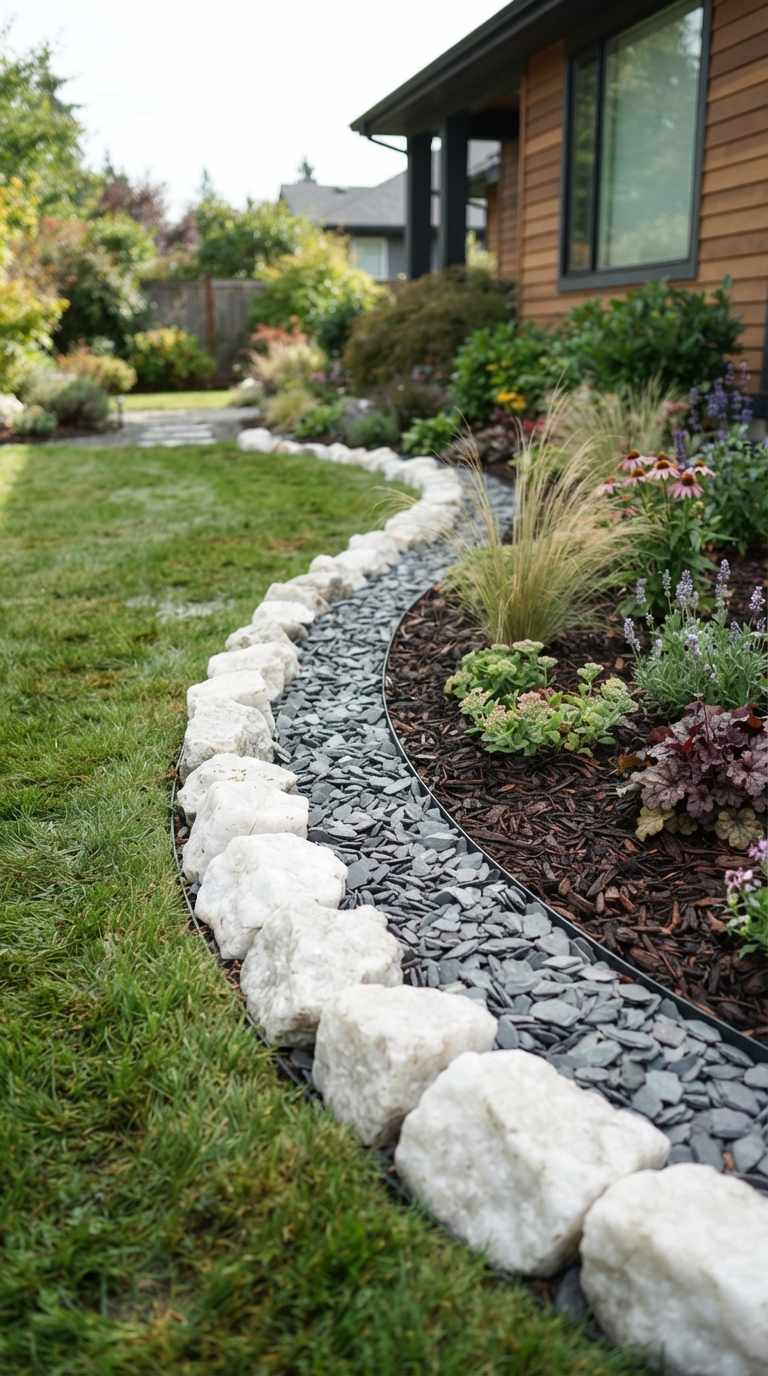
14. Bright White Rock and Slate Combination

This elegant border mixes big white quartz-like rocks with a sleek line of dark slate chips, creating high-contrast texture and color between the garden bed and lawn edge.
The form is crisply curved and modern.
When recreating this, separate bed and grass with metal edging for crisp lines.
This high-contrast approach works well in minimalist or contemporary landscapes that favor clean geometry.
15. Dry Stream Bed with Mixed Pebbles

This innovative border mimics a miniature dry stream beside a house, using larger rocks on edges and smaller, smooth pebbles filling the channel.
It guides water flow and accentuates the multi-level garden beds.
I love how this adds movement and sets a natural, peaceful tone.
To create it, dig a shallow channel and layer landscape fabric beneath the pebbles.
It’s an excellent option for drainage and aesthetic appeal in wetter climates.
16. Pure White Quartz Edging Rocks

Pure white, irregular quartz rocks line a garden border with clean separation from the lawn, brightening the entire planting area.
Their crystalline sparkle contrasts strongly with dark mulch and green plants.
This border adds an instant pop and shows off subtle plant colors.
Choose quartz for its weather resistance and give careful thought to rock size to prevent them from scattering or sinking.
17. Elegant Black Slate Stack Border

Thin sheets of black slate are carefully stacked upright to form a tall, textured border along a paved walkway.
The slate’s slate-gray tones complement both modern architecture and lush green plantings.
To reproduce this, collect thin flat stones and set them closely for a neat, solid wall feel.
This stone choice keeps the border slim but dynamic, perfect for tighter spaces needing vertical impact.
18. Wire Cage Gabion Wall Filled with Rocks

This contemporary edging uses rectangular wire cages filled with uniform river rocks to create a low retaining wall that is both functional and eye-catching.
The metal grid frames the stones, adding an industrial vibe.
For installation, choose sturdy galvanized or powder-coated wire baskets designed for landscaping.
This approach is ideal for steep slopes or erosion control and marries well with modern homes.
19. Jet Black Obsidian Spikes Line Garden

Sharp, glossy black obsidian stones stood vertically create a bold, spiky border that captures attention with their reflective surfaces.
They are set into black gravel to maximize dramatic contrast.
You should place these on iron or steel edging and avoid high traffic zones due to their sharp points.
This style works best in modern and dramatic gardens, emphasizing texture and shine.
20. Low Rectangular Granite Blocks

Short, rectangular granite segments with a rough cut surface create a neat and uniform border along a narrow garden bed.
The light gray color anchors the planting and provides subtle texture.
This solution is ideal for minimalist or northern climates.
Dry fitting the blocks initially can help plan curves and transitions before final installation.
21. Smooth Vertical Corridor of Pebbles

This border lays smooth, white oval pebbles arranged carefully in a flowing serpentine line, creating a gentle edge that enhances a desert style garden path.
The simplicity and repetition emphasize calm and continuity.
To replicate, ensure the ground is firm and level before setting the stones.
This fluid but restrained approach is a great alternative to more rigid stone borders.
22. Terracotta Cylinders Filled with Varied Pebbles

Rows of tall terracotta tubes act like mini pots, each filled with different colored pebbles, forming an artistic, playful edging.
The warm, aged patina of the clay contrasts beautifully with the smooth colorful rocks inside.
I recommend collecting a variety of pebble sizes and colors to maintain interest, and install the cylinders close together for continuous flow.
This is a great idea for Mediterranean or boho-inspired gardens.
23. Wavy Slate Stone Border

A sinuous edge made of upright, closely spaced multicolor slate stones creates a high-impact visual behind a stone-paved pathway.
The layered vertical edges resemble fish scales or piano keys offering movement and texture.
This works well in gardens with lots of path interaction, encouraging close attention and appreciation for small details.
Choose slate or similar flat stone for ease of vertical arrangement and durability.
24. Curving Pebble Mosaic Embedded Concrete

This bright border is a concrete form filled with beach pebbles and colorful glass shards, creating a shimmering mosaic alongside a gravel path.
The blending of rough stone and smooth glass gives an artistic, handcrafted effect.
You can recreate this by pouring a shallow concrete form and embedding materials while it’s wet.
This unique border adds personality and decorative detail to otherwise plain spaces.
25. Mixed Sized Lava Rock Mossy Wall

A textured low retaining wall constructed from irregular lava rocks that are naturally moss-covered, blending perfectly into a shady, moist woodland garden.
The irregular shapes and dark burnt tones give a rustic but alive quality.
Use lava rock from volcanic areas for this style.
The moss adds important softness and integrates the structure into the landscape, making it feel part of the garden’s ecology.
26. Black Edging with Dark Pebble Infill

A sophisticated flowing garden bed edge outlined in black metal with natural black pebbles filling the strip creates a slick, unified look.
The muted charcoal contrasts perfectly against the greener planting.
The black metal edging keeps clean geometry while the pebbles add textural interest.
This is ideal for modern gardens wanting subtle yet distinct borders that are durable and low maintenance.
27. Flat Stone Curves Defining Plant Beds

Large flat stones laid in gentle curves edge garden beds with lush, varied plantings.
The soft beige tones and rock’s natural fissures make the border feel inviting, blending with the pathway.
This method is perfect for creating naturalistic yet organized beds.
Ensure stones are partially set in soil or gravel to prevent shifting while allowing water penetration.
28. Looped Pebble Lines with Futuristic Feel

A creative border of smooth round pebbles assembled in double lines flowing in wavy patterns, enclosing planting beds in a neat but artistic fashion.
The pebble colors blend delicately from gray to tan.
This requires careful placement to maintain orderly shapes while retaining an organic flow.
You should set a landscape fabric underneath for weed prevention and use sharp edges to keep pebbles from spreading.

Leave a Reply