
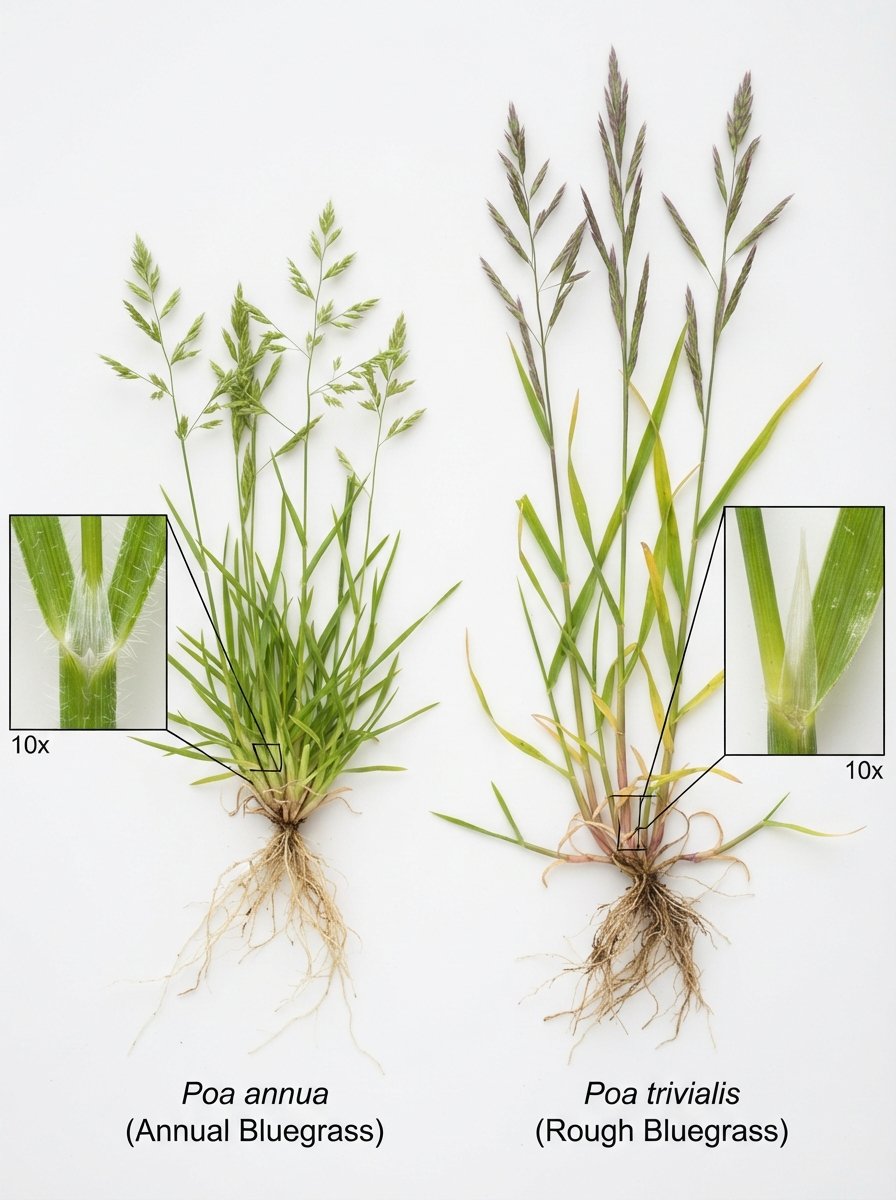
Distinguishing between Poa annua and Poa trivialis is essential for lawn enthusiasts, turf managers, and gardeners.
This guide unpacks the subtle botanical differences, growth habits, and environmental factors that separate these bluegrass species, equipping you to identify and manage them effectively.
Fundamentals of Poa Bluegrasses
Poa annua and Poa trivialis belong to the bluegrass genus Poa, but each species exhibits unique traits that influence where and how they grow.
Understanding these fundamentals is critical for accurate identification and management in turf environments.
Poa annua, often called annual bluegrass, typically completes its life cycle within a year, whereas Poa trivialis, known as rough bluegrass, is perennial and prefers moist, shaded habitats.
Both species can appear similar at a glance, sharing a fine texture and lime-green coloration, which can cause confusion among lawn care professionals and homeowners.
These commonalities, however, mask distinct physiological and ecological differences that affect their behavior in lawns, golf courses, and gardens.
Understanding these foundational characteristics highlights why successful management strategies, including lawn care, need to be species-specific.
A lack of awareness about their basic biology frequently results in mistaken control measures, leading to persistent infestations or lawn damage.
Key Morphological Differences

Examining the subtle morphological cues provides the most reliable method to differentiate Poa annua from Poa trivialis.
One critical feature is the ligule, the thin outgrowth at the junction of the leaf blade and sheath.
Poa annua’s ligule is short (3–6 mm) and distinctly jagged or lacerated, almost like tiny teeth.
By contrast, Poa trivialis has a longer ligule between 4–8 mm, which is smooth and membranous rather than jagged.
Additionally, the sheath texture is a giveaway; Poa trivialis possesses a rough or scabrous sheath covered with short hairs, while Poa annua’s sheath is smoother.
Careful inspection of these parts under magnification or with a hand lens often clears up identification challenges, especially because the leaf blades themselves may appear quite similar.
Relying solely on color or growth pattern can mislead, so developing familiarity with these physical details is indispensable.
Growth Patterns and Habitat Preferences
Poa annua thrives in compacted soils and varied environments, often appearing in disturbed areas and heavily trafficked turf.
It is incredibly adaptable but tends to dominate in open, sunny spots where its rapid life cycle gives it a competitive edge.
Poa trivialis, however, prefers moist, shaded, and cooler sites, frequently establishing in low-lying or damp areas where it forms dense, lush patches.
The perennial nature of Poa trivialis allows it to persist year after year, providing a different management challenge compared to the typically annual Poa annua.
The propensity of Poa trivialis to form thick mats under shade can be both an aesthetic advantage and a problem when it outcompetes desirable turf species.
Recognizing where these species naturally proliferate guides both identification and control strategies, ensuring treatments target the correct species tailored to the specific environmental context.
Root Structure and Seasonal Behavior

Poa annua generally produces shallow roots due to its rapid growth and annual lifecycle, making it more susceptible to drought stress and easier to pull from the soil.
Its seeds germinate in cooler weather, enabling it to quickly exploit seasonal openings in turf.
In contrast, Poa trivialis develops a more robust, spreading root system anchored in moist soil, which supports its perennial habit and resilience through adverse conditions.
This root depth enables it to sustain growth longer during drought or heat but also makes eradication more difficult.
Seasonality can also help differentiate them; Poa annua thrives mostly in spring and fall, producing seed heads frequently, while Poa trivialis emerges earlier and can remain active longer under milder conditions, a knowledge key for timing control methods.
Visual Identification in Turf Context

Spotting Poa annua and Poa trivialis in a lawn setting involves observing subtle color differences and texture nuances amidst surrounding grasses.
Poa annua often exhibits a lighter lime-green hue and a more tufted, loosely clumped growth habit.
Poa trivialis, on the other hand, produces a smoother, finer-textured turf with glossier leaf blades.
The photo vividly presenting young, narrow leaves shining with dewdrops shows Poa trivialis’ distinctive smooth, almost reflective leaf surface, which is a functional adaptation to its moist habitat.
Close proximity viewing enables identification of these textures and colors, especially in early morning or after rain when moisture highlights surface differences, allowing you to discern the grass species directly in the field.
Flowering Structures and Seed Heads

Flowering and seed-head morphology provide clear visual clues during identification.
Poa annua typically bears seed heads that are somewhat loose with fine downward-hanging spikelets and yellowish-green tones, whereas Poa trivialis produces denser, more upright and lush green panicles.
The pictured flowering blade shows a cluster of soft, pale-green seed heads emerging from healthy turf, highlighting the compactness and fine texture characteristic of Poa trivialis.
These bright inflorescences stand out against darker turf, often signaling the species’ presence before leaf traits can be fully assessed.
Observing these reproductive structures during late spring and early summer offers a crucial window for identifying and managing infestations based on their unique phenology.
Poa Trivialis in Shaded Lawns

Dense clusters of bright yellow-green Poa trivialis thrive prominently under shade and moist conditions.
This species often colonizes areas beneath trees or garden beds where reduced sunlight limits other grasses’ success.
The image captures a vivid patch of sunny yellow-green coloration amidst darker garden borders, illustrating how Poa trivialis stands out in the shaded garden microenvironment.
Its fine leaves and soft texture contrast sharply with surrounding soil and other turf species, making it visually distinct.
Such localized colonization frequently indicates excessive shade or moisture, suggesting management options focused on environmental modification.
Understanding this habitat preference prevents unnecessary herbicide use and promotes integrated approaches such as thinning shade or improving drainage to control Poa trivialis patches sustainably.
Poa Annua Cluster Growth Behavior

Clumped and pale, Poa annua often appears as irregular yellow-green patches intricately distributed within healthy turf, signaling an annual cycle of dieback and reseeding.
The photo illustrates a carpet of softly illuminated, light-yellow plants emerging in otherwise green turf, emphasizing how Poa annua forms distinctive mats in disturbed or open sun-exposed zones.
These dense tufts spread via seed, quickly colonizing bare spots that appear following drought or injury, which can be misleading as weed invasion.
Recognizing these patches helps you identify underlying turf stress and manage maintenance practices to discourage Poa annua reinfestation.
Addressing these clusters effectively demands ecological understanding and timing treatments during vulnerable growth stages, not merely visual spot spraying.
Lawn Damage Patterns and Diagnosis

Patches of dead and thinning turf can result from various causes, but distinguishing Poa annua and Poa trivialis damage requires observing the specific pattern and context of lawn injury.
The pictured lawn shows irregular brown, dying spots scattered across otherwise dense green turf, a symptom frequently associated with Poa annua infestation particularly under heat or drought stress.
These necrotic patches often develop as Poa annua plants die off in summer, leaving gaps prone to erosion or invading weeds.
Poa trivialis tends to create less widespread damage but may colonize damaged areas that remain moist.
Accurate diagnosis of damage patterns alongside species identification prevents misapplication of fertilizers, watering, or chemical controls, ensuring targeted, effective lawn care.
Common Identification Challenges
Many turf professionals struggle to reliably distinguish Poa annua from Poa trivialis due to overlapping features and environmental plasticity.
Relying solely on leaf color or growth habit often causes mistaken identity, as both species can appear similar when stressed or immature.
Additionally, seasonal changes alter leaf texture and sheath characteristics, complicating visual identification during certain growth stages.
Misidentification can lead to ineffective management plans, wasted resources, and exacerbated infestation.
To mitigate this, collecting multiple plant parts, observing under magnification, and integrating knowledge of site conditions are essential steps.
Patience and attention to detail in observation provide the confidence required to correctly distinguish these problematic bluegrass species.
Nuanced Tips for Field Identification
Mastering subtle identification cues elevates your turf management expertise.
One reliable field tip involves gently rubbing leaf blades to feel surface texture; Poa trivialis blades feel rough due to tiny hairs, whereas Poa annua blades are relatively smooth.
Checking ligules with a hand lens confirms diagnosis without damaging plants.
Another effective strategy is assessing plant behavior under moisture conditions; Poa trivialis often remains vivid in shaded damp soil, unlike Poa annua which pales quickly under stress.
Combining these tactile and visual checks with root pull tests improves confidence in identification.
Integrating multiple clues into a systematic approach, rather than relying on a single characteristic, prevents costly errors and streamlines control decisions on-site.
Targeted Management Strategies
Knowing which Poa species is present enables tailored interventions that optimize control and lawn health.
For Poa annua, pre-emergent herbicides timed before seed germination disrupt its life cycle effectively, while encouraging dense, vigorous turf through proper mowing and fertilization reduces open niches.
Poa trivialis management focuses more on cultural practices such as reducing excessive shade, improving drainage, and overseeding with competitive warm-season grasses.
Chemical control can be difficult due to its perennial habit and resilience.
Emphasizing integrated pest management principles, utilizing accurate identification, and considering environmental factors collectively enhance treatment success while minimizing collateral turf damage and environmental impact.


Leave a Reply