
Creeping bentgrass invasion can disrupt the beauty and health of your lawn, turning it patchy, uneven, and hard to maintain.
This guide walks you through identifying, controlling, and completely eradicating creeping bentgrass, offering deep insights and practical methods to restore your lawn’s lush uniformity.
Identifying Creeping Bentgrass in Your Lawn

Understanding exactly what creeping bentgrass looks like is the crucial first step in controlling it.
This shallow-rooted, creeping grass has distinctive narrow leaves and spreads aggressively via stolons or above-ground runners.
The root structure, shown in Image 1, reveals fine, fibrous roots with upright, thin blades branching out from a central crown.
In the inset, the smooth ligule characteristic,a translucent membrane,helps differentiate it from other grasses.
Mistaking creeping bentgrass for similar species can lead to ineffective treatment.
For example, other grasses may look broadly similar but lack stoloniferous growth or have broader leaf blades.
The intricate detail captured here in Image 1 shows its unique anatomy, crucial for accurate identification and targeted eradication.
Your actionable takeaway is to closely inspect your lawn for fine-textured, light green, needle-like blades with runners spreading across soil or existing turf.
Pull a small patch to examine the stem base and ligule under magnification to confirm the identification before proceeding with removal measures.
The Impact of Creeping Bentgrass on Lawn Health

Creeping bentgrass can be more than just a cosmetic issue.
Its aggressive growth often disrupts the uniform texture of your established turfgrass, resulting in an uneven appearance and compromised lawn density.
Unlike more desirable turf species, bentgrass forms dense patches through stolons that choke out native turf roots, making your lawn less resilient.
The image showing a stark contrast between healthy and scalped lawns (Image 7) illustrates how lawn care choices can influence weed encroachment.
The scalped lawn section, with its stress-exposed, yellowing grass, creates perfect conditions for creeping bentgrass to spread unchecked.
It’s essential to understand that creeping bentgrass thrives where turf is stressed or damaged.
Maintaining proper lawn health significantly reduces this threat, so focus on balanced mowing, fertilization, and watering to keep your turf competitive.
Common Mistakes That Encourage Bentgrass Growth
Many gardeners unknowingly create favorable conditions for creeping bentgrass by cutting corners in lawn care routines.
One frequent error is mowing the lawn too short, which stresses desirable grass and exposes soil, creating niches where bentgrass stolons can rapidly root and spread.
Overwatering or uneven water distribution is another pitfall.
Bentgrass prefers moist conditions, so excess watering weakens other grasses and gives bentgrass a competitive advantage.
Additionally, improper fertilization,either deficiency or excess nitrogen,can distort lawn vigor, indirectly supporting bentgrass invasion.
Correcting these habits is imperative.
Avoid mowing below recommended heights, water deeply but infrequently, and follow a balanced fertilization schedule based on soil testing.
These steps reduce the weak spots where creeping bentgrass can entrench itself.
Manual Removal Techniques: Digging and Cutting Bentgrass Patches

Physically removing bentgrass patches can be effective when infestations are localized.
The tactile process involves carefully lifting away bentgrass sod sections to remove stolons and roots, preventing regrowth.
Image 2 vividly captures this: a gloved hand peels back a thick slice of turf showing the embedded purple runners of creeping bentgrass spreading beneath.
Precision is key here; any leftover stolons left in soil encourage regrowth.
Following excavation, the exposed soil needs immediate attention,either reseeding or patching with compatible turf species,to avoid opportunistic weeds filling the void.
For best outcomes, target small patches early, removing a few inches beyond the visibly infested area to capture hidden runners.
Consistently inspecting your lawn after manual removal will prevent recolonization and help restore uniform turf cover.
Using Herbicides to Control Creeping Bentgrass

Herbicides can be a powerful ally in the battle against creeping bentgrass, especially for widespread infestations where manual removal is impractical.
Selecting the right pre- or post-emergent herbicide requires understanding active ingredients that specifically suppress bentgrass without damaging your preferred turf.
Image 3 dramatically shows a bentgrass patch deteriorating under treatment, the blades blanched and lifeless, a clear sign of systemic herbicide impact disrupting vital metabolic pathways.
This visual confirms the herbicide’s effectiveness in collapsing bentgrass stolons and leaves.
When applying herbicides, spot treatments or carefully calibrated broadcast spraying minimizes collateral damage.
Always follow label guidelines, apply during bentgrass active growth phases, and combine with cultural practices for sustainable control.
Restoring Lawn Areas After Bentgrass Removal

Once bentgrass is eradicated, restoring the bare or damaged patches with healthy turfgrass is vital to prevent re-invasion or weed intrusion.
Preparing the soil by loosening compacted areas and amending with organic matter optimizes root establishment.
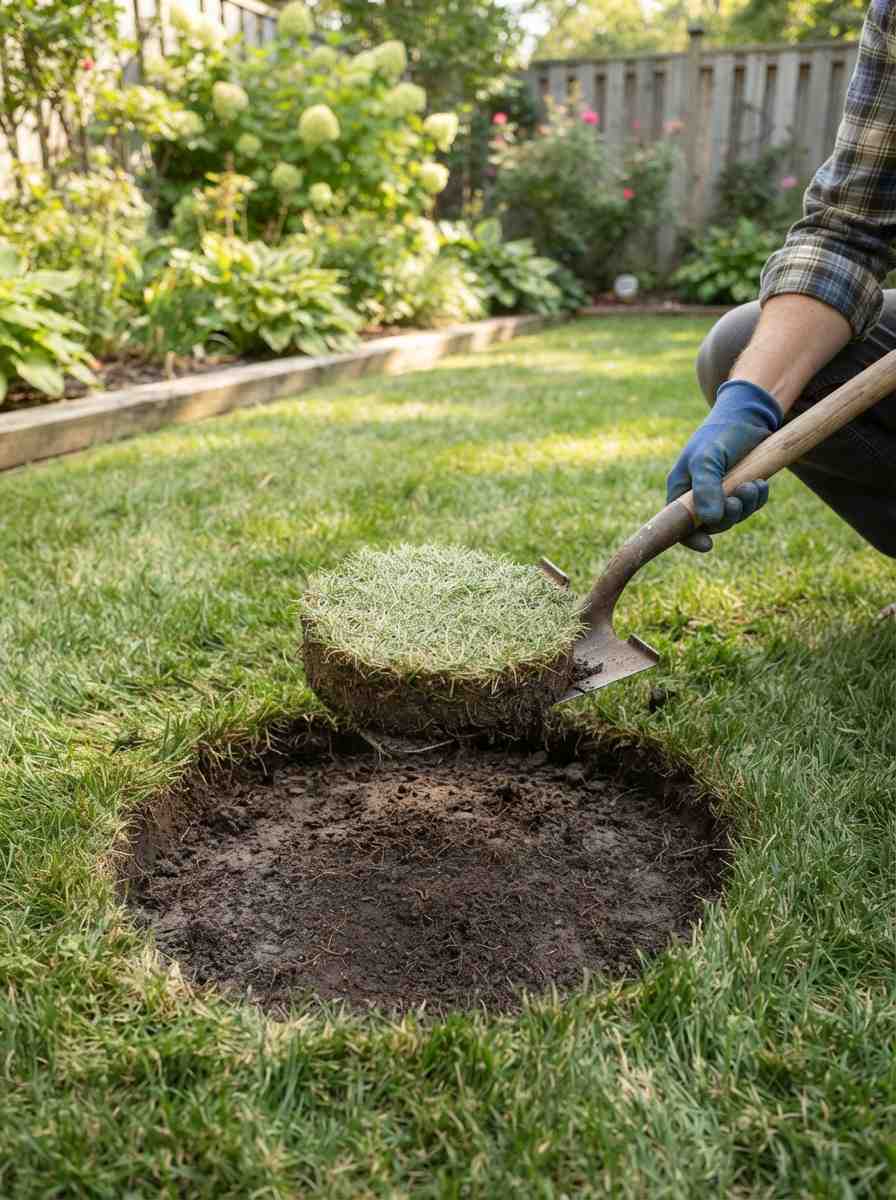
The photos in Image 4 feature the manual digging of a lawn divot, exposing fertile soil ready for reseeding or sodding.
The moist, freshly turned dirt boosts seed-to-soil contact, enhancing germination and rooting potential.
Timing restoration to coincide with optimal growing seasons and watering schedules ensures newly planted turf becomes established rapidly.
Regular monitoring and stress avoidance during this phase secure long-term lawn health free from creeping bentgrass.
Seeding and Overseeding Strategies Post-Bentgrass Removal

Overseeding with competitive turf species after bentgrass extraction strengthens lawn density and resilience.
Selection of seed varieties that thrive in your region’s climate and soil conditions is critical for success.
Image 5 displays a gloved hand spreading fine grass seed over a cleaned patch, demonstrating the importance of even seed distribution and gentle soil incorporation.
This meticulous approach fosters uniform grass development and rapid closure of vulnerable soil exposed after bentgrass removal.
To enhance germination, keep newly seeded areas moist and protect them from heavy foot traffic.
Repeated overseeding in subsequent seasons may be required to achieve a uniform, weed-resistant lawn.
Monitoring Lawn Recovery and Preventing Reinvasion

Post-treatment vigilance is the key to lasting success.
Regularly inspecting your lawn for signs of creeping bentgrass regrowth allows early interventions before extensive reinfestation.
Subtle cues include lighter colored needle-like grass patches, drying or thinning in previously treated areas, similar to the faint greenish creeping turf shown in Image 6.
These signals indicate stolon regrowth needing prompt spot treatment or manual removal.
Establish an ongoing lawn care routine emphasizing proper mowing height, watering, and fertilization.
Integrate occasional aeration and overseeding to bolster turf health and resilience against future invasions.
Understanding Bentgrass Growth Mechanisms
Creeping bentgrass spreads primarily through stolons,above-ground runners that root at nodes, rapidly forming dense mats that suffocate native turf.
These stolons root quickly and persist, making bentgrass a tenacious invader difficult to eradicate with surface treatments alone.
This growth habit allows bentgrass to exploit bare soil pockets and thin turf areas, expanding outward aggressively.
Moreover, its extensive stolon network can tolerate frequent mowing lower than many lawn grasses, giving it a further competitive edge.
Effective control thus requires interrupting stolon development through combined mechanical removal, targeted herbicide application, and restoration of healthy turf to outcompete reemerging bentgrass runners.
Environmental Factors Fostering Bentgrass Spread
Several environmental conditions favor creeping bentgrass dominance.
Soil compaction, poor drainage, and excessive shade weaken turf species less tolerant to stress, enabling bentgrass to establish.
Bentgrass thrives in moist, nutrient-rich soils and cool to moderate climates.
Prolonged wetness, for example after heavy rainfall or over-irrigation, increases bentgrass spread risk as seen in soft, patchy lawn areas.
Managing these factors involves improving soil aeration, reducing excessive watering, and pruning shade-casting plants to enhance air and light penetration.
These adjustments create an environment less hospitable to bentgrass encroachment.
Long-Term Lawn Care for Bentgrass Prevention
Preventing renewed creeping bentgrass infestations demands a sustained commitment to optimal lawn maintenance.
Core practices include mowing at heights that support the growth of your target grass species but discourage bentgrass expansion, typically around 3-4 inches depending on variety.
Balanced fertilization with judicious nitrogen promotes vigorous lawn growth without encouraging thin or weak patches bentgrass can exploit.
Maintaining soil pH near neutral also supports healthy root systems.
Frequent monitoring and rapid intervention upon detecting bentgrass emergence solidifies your lawn’s defense.
Integrating cultural, mechanical, and chemical management with tailored seasonally adjusted care preserves long-term turf uniformity and beauty.



Leave a Reply