
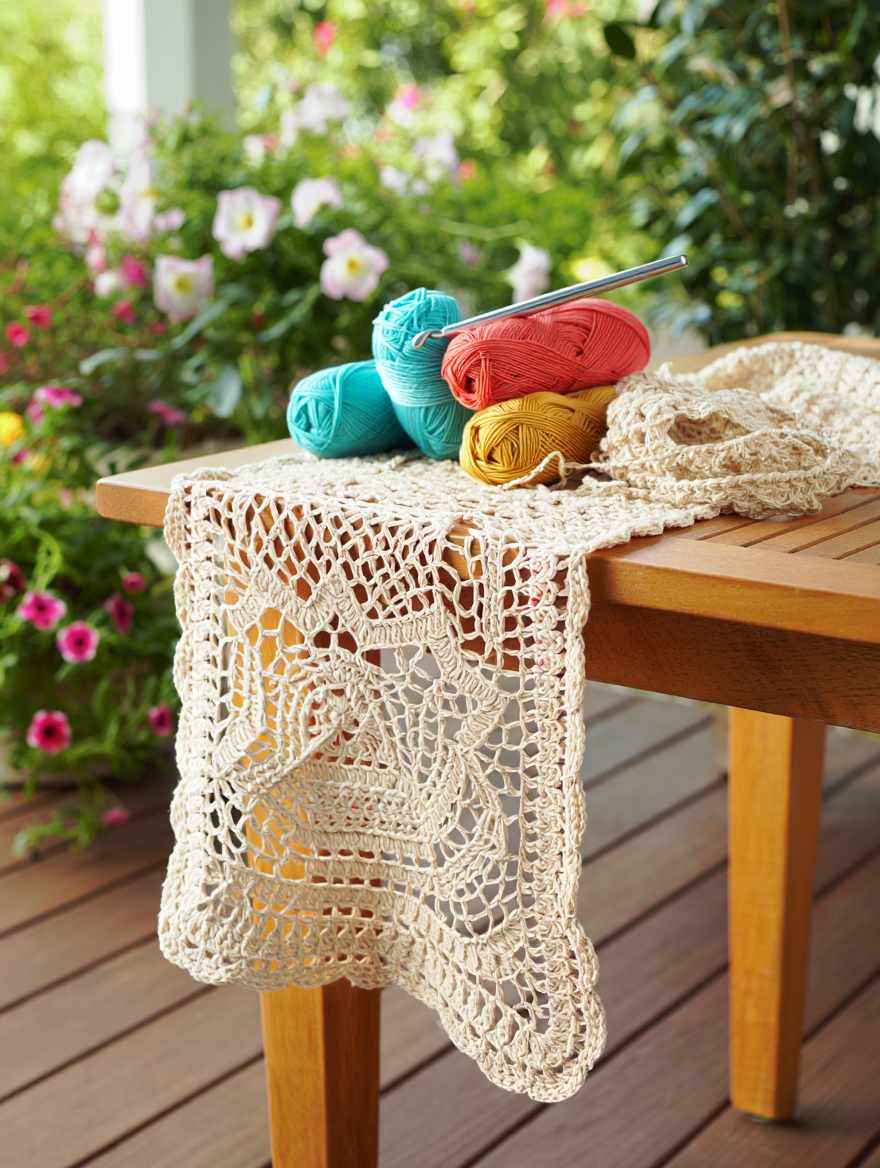
As I sat on my sun-drenched porch, the soft summer breeze played with my hair while I explored the intricacies of crochet.
My hands danced with yarn, crafting the splendid Aunt Lydia’s Boho Nights Doily.
This article will take you on a journey to perfect this delightful project, blending creativity and skill in every stitch.
Gathering Your Materials
To begin, having the right materials is essential to the successful completion of Aunt Lydia’s Boho Nights Doily.
You will need size 10 crochet thread in your preferred color.
Opt for vibrant shades like turquoise or soft pastels that reflect your personal style and the ambiance of your home.
The contrast between the colors and the delicate stitches will enhance the final appearance of the doily and bring it to life.
A size 1.5 mm steel crochet hook is recommended for this project.
This particular size allows for precise stitch work, which is crucial for maintaining the integrity of your doily’s design.
If you’re unsure about your hook size, test a few stitches on scrap yarn to ensure you achieve the desired tightness.
The wrong hook can lead to an unbalanced and floppy doily, which is a common mistake for beginners.
Finally, don’t forget essential tools like scissors for trimming ends, a tapestry needle for weaving in those pesky loose threads, and blocking materials to set the final shape.
Blocking is often overlooked but is vital; without it, the doily may lose its intended form and elegance.
To block effectively, you’ll want to pin it to a mat after washing and allow it to dry completely in that shape.
With your materials ready, set the stage for your creative process.
I recommend organizing your workspace to minimize distractions.
Having everything within reach, from yarn to blocking materials, ensures a smooth flow and encourages consistency in your stitching.
Understanding Crochet Abbreviations

Before diving into the pattern, understanding common crochet abbreviations is helpful.
Familiarize yourself with terms like ‘ch’ for chain, ‘dc’ for double crochet, and ‘sc’ for single crochet.
These abbreviations streamline patterns, making them concise yet impactful.
For instance, if you misinterpret a ‘sc’ as ‘dc,’ you might end up with an entirely different texture and shape.
Consider joining a crocheting community or forum where you can ask questions and share tips.
Real-world examples abound of crocheters tackling this very task, and many even keep a handy guide of abbreviations pinned to their workspace.
Experiment with different stitches and practice each abbreviation to build confidence.
This hands-on approach will aid your understanding and enhance your technique as you progress through the pattern.
As you work, keep track of your stitches.
It’s easy to lose your place if you’re distracted or if the pattern becomes repetitive.
A common mistake I’ve encountered is forgetting to count during long rounds, leading to uneven edges.
Make it a habit to periodically recount your stitches to spot errors early on.
To simplify this process, I recommend jotting down your stitch counts after every round.
This method not only organizes your progress but also allows for easy corrections if you happen to deviate from the pattern.
Beginning Your Doily: The Foundation Ring
With your materials set and your understanding of abbreviations in place, it’s time to start the Aunt Lydia’s Boho Nights doily with the foundation ring.
This is the bedrock of your design, and I can’t emphasize enough the importance of this initial step.
To create the foundation, chain ten stitches and join with a slip stitch to form a ring.
This might seem simple, but many beginners struggle with achieving a tight and secure starting point, which lays the groundwork for your pattern.
When forming your foundation ring, ensure you maintain an even tension.
Too tight of a foundation can lead to difficulty in adding subsequent rounds, while too loose will make your piece floppy.
A useful tip is to gently pull on your ring as you work.
This adjustment helps create a snug fit as you progress.
During Round 1, you’ll work 25 double crochets into the ring, creating a total of 26.
This round establishes your first layer of stitches, so make sure you are comfortable with your double crochet technique.
If you find your stitches uneven or disproportionate, take a moment to adjust your tension before moving on to the next round.
Many crocheters skip checking their work at this stage, only to find discrepancies pop up in later rounds.
Don’t make this mistake,it’s best to correct any issues now, while they are still manageable.
As you finish Round 1 by joining with a slip stitch to the first double crochet, you will feel a sense of accomplishment as you see the beginning of your doily emerge.
Constructing the Layers: Rounds 2 to 5
As you embark on Rounds 2 to 5, remember that this is the heart of your doily’s design.
Each stitch plays a crucial role in creating the intricate patterns that define the Boho style.
In Round 2, for instance, working (dc, ch 3, dc) into the next double crochet creates delicate clusters that provide dimension.
It’s fascinating to see how simple stitches can combine to make beautiful motifs.
However, make sure to follow the instructions closely.
I once missed a crucial ‘skip the following dc’ step, resulting in an uneven pattern that didn’t mirror the intended bohemian feel.
Such errors can be discouraging, so it’s vital to keep a steady pace and pay attention to each round.
It may help to vocalize or write down your steps as you go, reinforcing your learning process.
By Round 5, you will begin to see the intricate layout taking shape.
The beauty of the doily often lies in the combination of stitches weaved throughout, facilitating both visual interest and texture.
Utilize the ch-2 spaces to add complexity and keep the doily light and airy.
Each chain space invites the design to breathe while enabling the doily to lay flat when finished.
A common mistake at this stage includes misunderstanding the term ‘repeat from *’ within patterns.
It can alter your stitch count significantly if miscounted, leading to unexpected results.
To prevent this, highlight or mark the instructional asterisks in your pattern, making it easier to follow the designated repetitions.
Adding Dimensions: Rounds 6 to 12

As you progress through Rounds 6 to 12, pay close attention to the increasing dimensionality of the doily.
The inclusion of double crochets, chain spaces, and varied groupings contribute to a striking visual layout that enhances the overall design.
By introducing 2 dc in certain stitches, you are building texture and increasing the doily’s character.
To achieve the desired depth, I recommend adjusting your tension based on the feel of the yarn.
The type of crochet thread you select can significantly affect your results; softer threads may yield a fluffier texture while stiffer ones provide sharper edges.
Always perform a stitch test with your material to understand how your thread reacts under tension before starting each new round.
Throughout these rounds, ensure you maintain your stitch count diligently.
It’s easy to lose track, especially when excitement builds up as you start to see the design unfold.
Trust me,keeping a stitch counter or a notepad handy will save you from potential frustration later when you notice an incorrect stitch count.
Moreover, this stage is an excellent opportunity to experiment with color placement.
If you have chosen multiple thread colors, plan which round will introduce each new hue, creating a more dynamic doily.
This color strategy can elevate the bohemian aesthetic you are aiming for, allowing personal expression throughout your creation.
Finalizing Your Doily: Rounds 13 to 20
Reaching Rounds 13 to 20 is both thrilling and momentous.
This section is where your doily really begins to take a life of its own, and you’ll appreciate the thought and effort that has gone into each round.
As you build upon the previous layers, the challenge increases, but so does your skill and confidence.
Round 19 introduces new elements such as chain spaces that create a lattice-like structure.
Striking the right balance between tight and loose stitches can greatly affect the aesthetics of your final product.
If your stitches are too tight, the doily might pucker; if too loose, it could lose its shape.
A common rule of thumb is to ensure your last few stitches of each round mirror the same tightness and spacing as your initial rounds.
Keep a keen eye on visual consistency during this phase.
Many beginners fall into the habit of losing focus on their initial vision, resulting in a mismatched look.
To counter this, compare actively with photographs of finished doilies, ensuring your piece remains harmonious with your creative vision.
Once you reach Round 20, your excitement will peak.
This round, focusing on detailing like the single crochet stitches and added chain spaces, makes all the difference.
Don’t forget to fasten off securely, as this ensures stability in your doily’s structure.
After completing the final stitch, take a moment to admire your creation before moving onto the finishing touches.
Finishing Touches: Weaving and Blocking

With the main body of your Aunt Lydia’s Boho Nights Doily complete, the finishing touches are what will elevate it from just ‘completed’ to ‘exquisite.’ First, you will need to fasten off your thread.
A mistake some people commonly make here is leaving excess length, which can create bulkiness that detracts from the overall elegance of your work.
I recommend keeping a manageable length of about 6 inches before fastening off.
Next, weaving in ends can often feel tedious, but it’s necessary for a professional finish.
Use a tapestry needle to go through the stitches of the same color, keeping it as unobtrusive as possible.
Doing this ensures that your ends are secure and don’t become visible during use.
Remember, the goal is to create a polished look that truly showcases your craft.
After you have woven in your ends, blocking your doily will help set its shape, ensuring the delicate design shines through.
Lay it flat on a blocking mat and pin it in place, adjusting the edges to create a neat finish.
Many beginners overlook this step, resulting in a doily that curls and loses its intricate designs.
Blocking takes patience, but establishing the right form will enhance the overall aesthetic immensely.
Finally, after blocking, give your doily a gentle wash.
This not only cleans but also softens the fibers, presenting a luxurious texture.
Use cold water and a gentle detergent to avoid damaging the thread.
Let your doily air dry completely before displaying it to truly appreciate the craftsmanship you’ve poured into this lovely piece.
Showcasing Your Doily: Practical Applications
Now that you have successfully completed Aunt Lydia’s Boho Nights Doily, it’s time to consider how you will showcase your beautiful creation.
One inspired option is to use it as a centerpiece on your dining table, layered under a vase of fresh flowers to create a lovely bohemian vibe that enhances your décor.
Alternatively, you may choose to place your doily in other areas of your home.
Consider using it as a decorative piece on a side table or as a delicate table runner.
Each placement can alter the atmosphere of your space, reflecting different styles from rustic to chic while showcasing your crocheted art.
Remember, it’s not just a doily; it’s an expression of your creativity.
Many crafters also choose to gift their handcrafted items, making a personalized touch for friends and family.
Attach a tag that explains the crafting process and care instructions,this additional detail adds a heartfelt element to your gift that recipients will treasure.
Don’t shy away from sharing your completed doily online.
Social media platforms and crochet communities are wonderful avenues to showcase your work and inspire others.
A picture of your finished piece amongst flowers or cozy decor can showcase its charm while receiving feedback and admiration from fellow crafters.



Leave a Reply