
Creating privacy in your outdoor space doesn’t have to drain your budget or demand major renovations.
With clever, low-cost solutions,from living plants to repurposed materials, you can effectively screen your yard from prying eyes while enhancing your environment’s beauty and functionality.
Discover versatile, inexpensive ideas to reclaim your personal space.
Why and How to Create Affordable Outdoor Privacy
The main challenge when seeking privacy outdoors is balancing cost, effectiveness, and aesthetics.
Many homeowners want to block neighbors’ views without investing in high-priced permanent fencing or complicated installations.
These affordable ideas focus on quick implementation and versatile options, using natural elements, DIY projects, or portable screens to solve common privacy issues creatively.
Before selecting your privacy method, assess your space constraints, climate, maintenance willingness, and budget.
Some solutions thrive in sunny gardens, others excel on balconies or urban patios.
Choosing plants or materials suited to your location and lifestyle ensures your privacy screen lasts and performs well year-round, offering comfort without hassle.
1. Grow Tall Corn for a Dual-Purpose Privacy Screen

Using tall, mature corn plants provides a natural, inexpensive screen that grows well above typical fences to block neighbors’ view while producing food.
Corn’s height and dense stalks create an effective barrier by filling vertical space in a backyard.
Raised beds enhance soil quality and drainage, boosting plant health and vigor for a more reliable screen.
Regular watering, as suggested by the garden hose nearby, is essential for stalk development and leaf density.
Planting in late spring ensures mid to late summer privacy.
This method works well in medium-sized yards where you can dedicate space for edible landscaping that serves both privacy and utility.
2. Repurpose Folding Shutters as Adjustable Privacy Screens

Transforming weathered wooden shutters with hinged panels into a folding screen lets you create a flexible visual barrier on patios or gardens at low cost.
The horizontal slats partially obscure sightlines yet allow airflow, while the adjustable panels enable customizable coverage for varying privacy needs.
Adding potted herbs at the base softens the screen’s bottom edge and integrates the setup into garden spaces naturally.
Vintage or worn shutters offer charm and are easy to install without permanent fixtures, making this a good pick for renters or those wanting a non-committal privacy option.
3. Climb Clematis on a Wooden Trellis for Seasonal Screening

Installing a wooden trellis with wire grid provides a sturdy framework for fast-growing climbers like Clematis ‘Jackmanii’, which delivers dense foliage and vibrant flowers to block neighbor views.
The lush purple flowers not only add beauty but highlight the privacy function during late spring and early summer.
Combining hostas at the base enhances layering and visual fullness.
Selecting vigorous climbers ensures rapid coverage, but some pruning is needed to maintain thickness and prevent gaps.
Trellises are ideal for compact gardens where vertical privacy beats horizontal expansion.
4. Use Vertical Living Fern Walls for Lush, Compact Privacy

Vertical gardens with grow bags or pockets filled with Boston ferns and other trailing ferns maximize limited patio space to form dense, textural green privacy walls.
Ferns’ full, feathery fronds prevent direct sightlines while providing a cool, natural feel.
Efficient water retention in grow pockets and positioning on a sunny but sheltered patio encourages year-round vitality.
Regular trimming stops plants from becoming too sparse or unruly.
This technique suits smaller yards or urban decks needing a vibrant yet flexible green shield.
5. Create Vertical Pallet Gardens with Succulents for Partial Screens

Mounting wooden pallets vertically and filling their slats with drought-tolerant succulents forms a rustic, partially transparent privacy screen that softens intrusive views without heavy blocking.
Succulents require minimal water and thrive in sun-exposed yards.
Arranging pots evenly promotes uniform coverage while allowing light to pass through.
Attaching pallets securely supports plant weight.
This budget-friendly method combines sustainable reuse and greenery for small spaces that benefit from both aesthetics and privacy.
6. Train Ivy on Wooden Lattices for Affordable Green Barriers

Attaching English ivy to freestanding wooden lattices creates a simple, inexpensive privacy solution that improves over time as vines grow denser.
Ivy’s glossy leaves effectively fill lattice gaps to obscure neighbor views while remaining breathable and light-filtering.
Securing lattice firmly prevents lean or collapse from vine weight.
Ivy tolerates shade and requires occasional trimming to maintain coverage and prevent invasive spread.
This green screen suits suburban yards with moderate sun exposure and limited budgets.
7. Maximize Small Balconies with Vertical Plant Grids

Vertical wooden frames with metal grids support a mix of hanging and potted plants that grow into a living privacy curtain on compact balconies.
Combining Boston ferns, spider plants, pothos, and ivy creates dense, layered coverage to screen neighbors’ views effectively.
This setup capitalizes on vertical space, ideal for tight urban outdoor areas.
Regular watering and rotation of plants maintain vigor and prevent bare spots.
Varying plant types extends seasonal privacy and provides textural interest, balancing beauty and function.
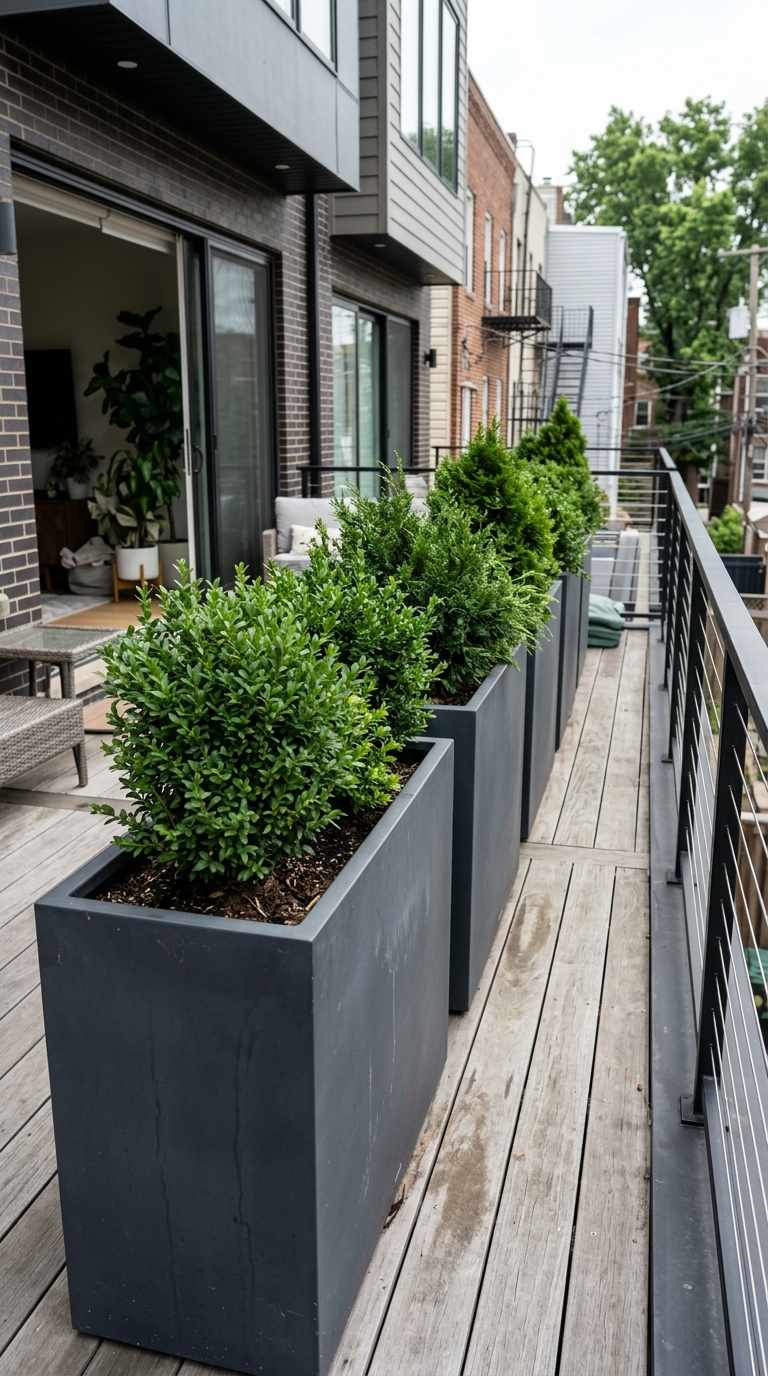
8. Plant Evergreen Shrubs in Planters to Block Urban Balconies

Tall evergreen shrubs like boxwoods placed in heavy planters enable renters or urban apartment dwellers to establish a controlled, natural-looking privacy hedge without altering permanent architecture.
Consistent spacing and shrub maintenance help form a thick, lush barrier.
Planters on decking ensure root health with good drainage.
Slow-growing shrubs require trimming for tight foliage but reward with year-round green visual screening.
This solution is scalable and movable for evolving privacy needs on limited terraces.
9. Plant Arborvitae Rows for Evergreen, Low-Cost Privacy Hedges

Arborvitae (Thuja occidentalis) are evergreen trees that create a dense, conical hedge providing a thick year-round visual and sound buffer.
When planted closely and maintained properly, they grow tall enough to exceed standard fences, ensuring full privacy.
Spacing about 2-3 feet apart accelerates hedge formation and prevents gaps.
Using mulch around tree bases conserves moisture and prevents weeds, fostering healthy foliage growth.
This practical living barrier works well in suburban yards seeking natural privacy.
10. Use Potted Clumping Bamboo for Tall, Flexible Screening

Tall, slim bamboo varieties in large planters serve as portable, space-conscious privacy screens that add tropical texture and a natural barrier.
Clumping bamboos avoid invasive spreading, making container growing manageable and low-maintenance.
Spacing planters evenly allows airflow to reduce fungal issues while promoting upright growth.
Bamboo’s dense foliage grows fast, producing year-round screening effect.
Concrete containers provide stability and contrast aesthetically with greenery, ideal for patios or terraces requiring adjustable privacy.
11. Construct Simple Bamboo Fences for Eco-Friendly Boundaries

A semi-opaque bamboo fence made from vertical poles tied with natural fiber rope offers partial visual screening that’s lightweight yet functional.
Its moderate height suits garden edges in coastal or sandy soils where thicker fences might be out of place.
Bamboo’s natural color harmonizes with surrounding plants and earth tones.
The fence allows light and breeze to pass through, preventing a heavy, closed-in feeling.
Rustic ties and uneven pole heights add character while ensuring reasonable coverage at a low cost.
12. Attach Reed Screens to Chain-Link Fences for Quick Privacy

Lining chain-link fences with reed or thin bamboo canes offers a low-cost, simple upgrade that substantially increases privacy by blocking direct lines of sight while preserving airflow.
Ziptie attachments make installation fast and reversible.
Reed screens are best for suburban yards where modest height and natural aesthetics fit.
They weather gracefully and are lightweight but may require yearly replacement depending on exposure.
This method improves fencing without expensive materials or permits.
13. Use Tall Ornamental Grasses in Metal Planters in Urban Spaces

Tall grasses like feather reed grass in rust-colored corten steel planters form a natural but ephemeral visual screen suitable for city sidewalks or patios.
Their vertical stems and feathery plumes break up harsh urban lines while partially blocking views.
Planters protect roots in confined areas and add texture contrast between metal and soft grasses.
Grasses let light filter through, avoiding a claustrophobic feel and require minimal maintenance beyond late-season trimming.
This approach suits urban dwellers balancing privacy with openness.
14. Install Decorative Corten Steel Panels for Stylish Screening

Freestanding rust-colored corten steel panels with geometric cutouts provide semi-opaque privacy allowing airflow and light filtration.
Their weathered, natural appearance complements xeriscaped deserts or dry gardens, making them both functional and artistic.
Panels require minimal maintenance and resist harsh climates.
Positioning them among succulents and cacti blends them into arid environments seamlessly.
For those wanting privacy without full visual blockage or bulk, this offers a durable and visually interesting solution.
15. Install Fabric Privacy Panels on Fence Posts for Instant Screening

Mounting opaque, weather-resistant fabric panels between backyard posts offers a quick and cost-effective way to block views while waiting for planted shrubs to mature.
The tight polyester or polyethylene mesh blocks direct sightlines and requires minimal installation tools.
Spacing plants at the base prepares for a layered natural screen as they grow.
Combining fabric with growing greenery balances immediacy and permanence.
Installing clean, taut panels avoids sagging and wind damage, enhancing longevity and visual appeal.
16. Harness Colorful Shade Sails to Privacy and Sun Protection

Stretching triangular fabric shade sails over patios blocks upper-story views while simultaneously shading outdoor areas, combining privacy and comfort.
Layered colors and tensioned installation offer visual interest and flexible coverage.
Steel posts and house attachment points ensure stability.
Selecting UV-resistant sail fabric prolongs lifespan.
Adjusting sail placement adapts to seasonal sun angles and privacy needs.
This semi-permanent solution is ideal for modern designs seeking multipurpose outdoor screening.
17. Add Retractable Mesh Screens for Seasonal Privacy Control

Retractable outdoor mesh screens mounted on decks provide versatile privacy that can be extended when needed and rolled away to open space.
This flexibility is ideal for blocking views from neighboring windows or yards temporarily.
Fine mesh allows light and air while obstructing sightlines.
A sturdy metal frame ensures durability against wind and regular use.
Installing near dining or seating areas maximizes outdoor comfort and discretion.
This approach adapts easily to changing privacy requirements throughout the year.
18. Attach Outdoor Curtains to Pergolas for Flexible Privacy

Hanging semi-sheer outdoor curtains from pergolas offers adjustable privacy that can be opened or closed as needed, ideal for patios lacking permanent fences.
Curtains block sightlines while maintaining airflow and letting in diffused light, enhancing comfort.
Using weather-resistant fabric with grommets ensures durability and ease of sliding.
Pairing with potted ferns and snake plants integrates the setup with garden greenery.
This method suits smaller spaces needing a seasonal or temporary privacy solution without structural changes.
19. Combine Patio Umbrellas with Fences for Layered Privacy

Using a large cantilevered umbrella adds vertical shielding over standard fences, especially from upper-floor windows that traditional fencing can’t block.
This overhead element reduces sightlines from neighboring balconies or second stories.
Positioning the umbrella strategically protects seating areas and enhances outdoor comfort with shade.
Incorporating potted plants alongside strengthens enclosure effects without additional construction.
Umbrella size and color choice affect privacy coverage and visual impact, so plan accordingly.
20. Grow Wisteria on Pergolas for Flowery Overhead Screening

Training lush wisteria vines over pergolas creates a thick, elevated privacy barrier enhanced by cascading spring blossoms.
The sturdy woody stems support dense foliage that screens neighbors’ views at height rather than ground level.
Wisteria requires patience and structural reinforcement but rewards with intense coverage and seasonal color.
Regular pruning maintains shape and prevents overcrowding.
This natural overhead canopy transforms outdoor spaces, offering a private retreat shielded by living architecture.
21. Install Horizontally Slatted Wood Fences for Modern Privacy

A horizontally slatted fence made from cedar or redwood creates a contemporary, warm barrier that fully blocks neighbors’ views when boards are spaced tightly.
This design combines function and form, adding an architectural element to yards while ensuring year-round seclusion.
Metal posts add durability and sleek contrast.
Landscape additions like ornamental grasses soften the base and prevent erosion around posts.
Planning fence height based on local rules and neighbor sightlines ensures an effective shield without feeling too oppressive.
22. Use Frosted Glass Panels for Elegant, Semi-Opaque Privacy

Frosted glass privacy screens etched with leaf patterns block direct neighbors’ views while filtering natural light, creating a bright but secluded outdoor area.
Mounting panels on metal posts adds stability and a sleek modern aesthetic.
The semi-transparency prevents a closed-off feel, balancing openness with seclusion.
Cleaning glass periodically maintains clarity and appeal.
This choice works well for homeowners seeking refined, low-maintenance outdoor privacy solutions with a contemporary edge.
23. Build Rock-Filled Gabion Walls for Durable, Natural Screening

Gabion walls, formed by wire cages packed with river rocks, deliver a heavy-duty, maintenance-free privacy barrier that resists weather and growth cycles.
Their solid mass completely blocks sightlines while blending into natural landscapes, perfect for semi-arid or rugged settings.
Though installation requires effort and materials, gabions avoid the upkeep of living hedges and provide immediate privacy.
The rocks’ neutral tones complement surrounding vegetation, and the structure’s modular nature allows customization of height and length to suit your needs.
24. Place Artificial Boxwood Panels on Planters for Mobile Privacy

Artificial boxwood walls mounted on wheels provide an instant, year-round green screen that requires no water, pruning, or seasonal upkeep.
Their dense faux foliage is designed to look natural and block sightlines effectively on decks or rooftops.
Mobility allows repositioning to suit changing privacy needs or outdoor layouts.
Though they lack living plant benefits, maintenance savings and durability make artificial screens smart choices for urban settings with limited soil or sunlight.
Leave a Reply